
Content Hub: What It Is and How to Build One From Your Webinar Content


Most teams treat content creation and content organization as two separate problems. First you write the posts, record the videos, commission the guides. Then, later, someone tries to organize all of it into something that looks like a hub.
That order is backwards, and it's why most content hubs stall out after the launch push. The real bottleneck was never structure. It was supply. And if you're already running webinars, you're sitting on the highest-leverage supply source most B2B teams aren't using.
What is a content hub?
A content hub is a structured collection of content built around one core topic — typically a central page (the pillar) linked to a set of supporting pages (the cluster) that each go deeper on a specific angle, question, or keyword variant. The hub signals topical authority to search engines through internal linking and comprehensive coverage, and it gives visitors a reason to keep clicking instead of bouncing after one article.
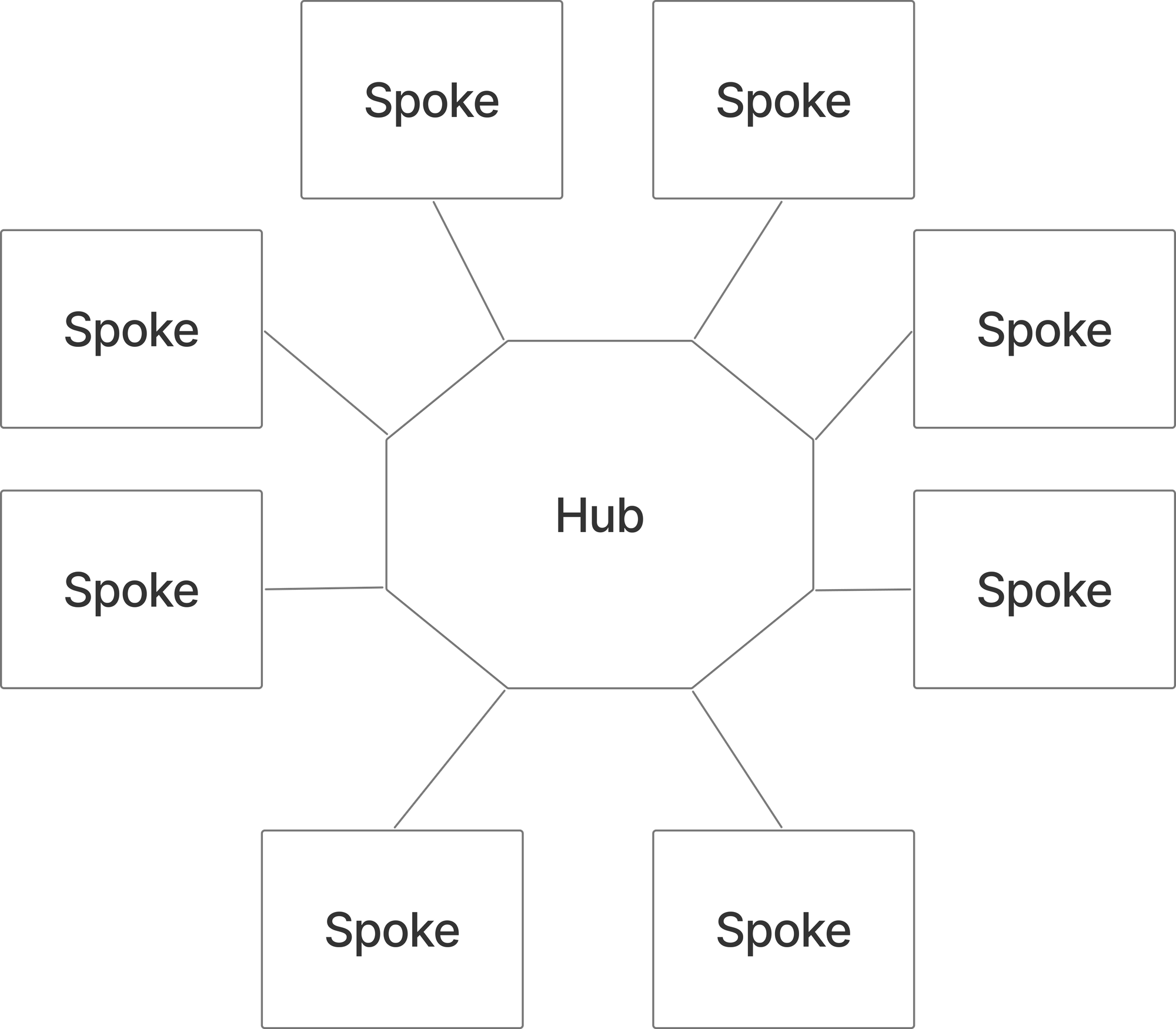
That's the standard definition, and it's not wrong. It's just incomplete. It describes the shape of a hub without saying anything about where the content inside it is supposed to come from — and that's the part that actually breaks in practice.
Why most content hub strategy stalls at launch
A hub-and-spoke structure needs a steady stream of new cluster content to stay alive. Miss that, and you get a pillar page with three supporting posts from the launch sprint and nothing since. The common failure isn't picking the wrong architecture. It's running out of raw material to fill it.
Most B2B teams already have a recurring source of raw material and don't use it as one. If you run one webinar a month, you generate an hour of expert conversation, real questions from a real audience, and a recorded argument for your point of view, then let it sit as a single video on a single page. One Contrast webinar built almost entirely around this idea put it directly: most marketing teams treat a webinar as one-and-done, when video "is kind of like text, you write it once, you use it multiple times."
Contrast's own numbers back up how rarely this actually happens: on average, only around 20% of webinar content gets repurposed into other formats, even though a majority of B2B marketers already say webinars are part of their content strategy. That gap tracks with a broader pattern in how B2B content actually performs: the Content Marketing Institute's B2B research has found that a documented content strategy correlates with meaningfully better results than ad hoc content production — and a repurposing pipeline is, in effect, a documented strategy that runs itself. A single recorded session, treated properly, isn't one asset. It's raw material for ten.
Webinar content repurposing: how one session becomes hub infrastructure
Here's the reframe: don't build a content hub and separately decide to include webinars in it. Build the hub out of the webinar. The pillar-and-cluster structure a generic content strategy guide tells you to construct by commissioning a dozen individually-briefed articles can instead come from one recorded conversation, cut a dozen different ways:
- The pillar page: a long-form article drawn from the full transcript, targeting the head-term keyword
- Cluster posts: shorter pieces built from specific sections — a sub-topic raised at minute 12, a question asked in Q&A, an example the speaker walked through
- Clips: short, captioned video pulled from the moments with the strongest hook — a specific number, a contrarian claim, a concrete anecdote
- A newsletter send and a LinkedIn post: different framings of the same core argument, for audiences who won't read the blog
- Quote cards and highlight graphics: pull-quotes and stats formatted for social, sourced directly from what was actually said
- A permanent home: every session added to a branded, persistent channel page — not buried in a "past webinars" folder three clicks deep
That structure is a hub. It just started from a conversation instead of a content calendar.
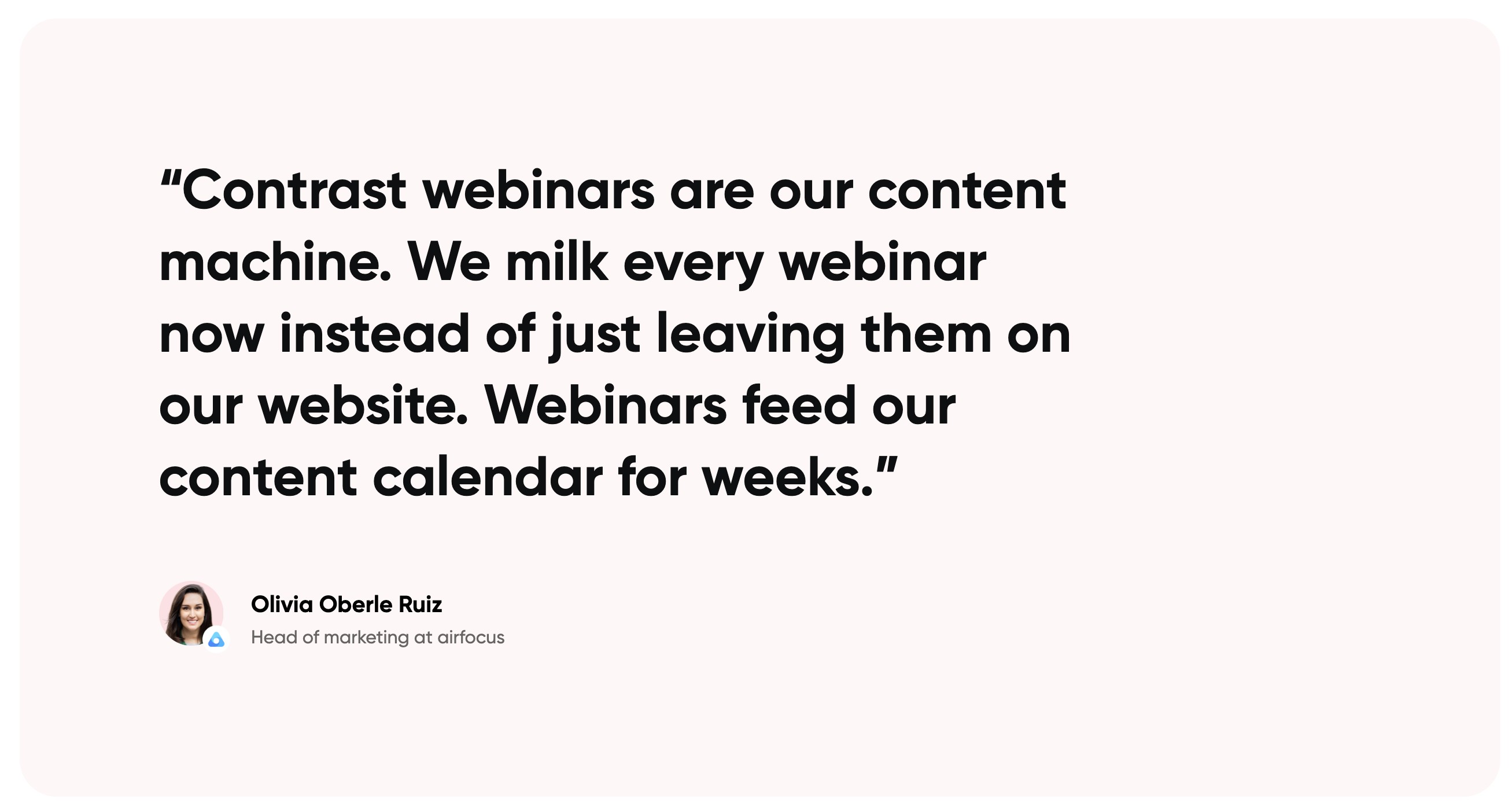
Contrast's Repurpose AI builds this pipeline directly into the product: it transcribes and indexes the session, then generates a summary, a blog draft, a LinkedIn post and newsletter copy from any selected part of the transcript, alongside 5 AI-suggested short clips scored for how likely they are to land. That's the same webinar repurposing mechanism that turns a recording into hub-ready material without a separate editorial pass for every format. Olivia at airfocus, whose team runs on this workflow, put it plainly: "Contrast webinars are our content machine." At least 75% of the blog articles her team publishes from webinars start with an AI-generated draft that a person then edits — not a fully manual process, and not fully automated either.
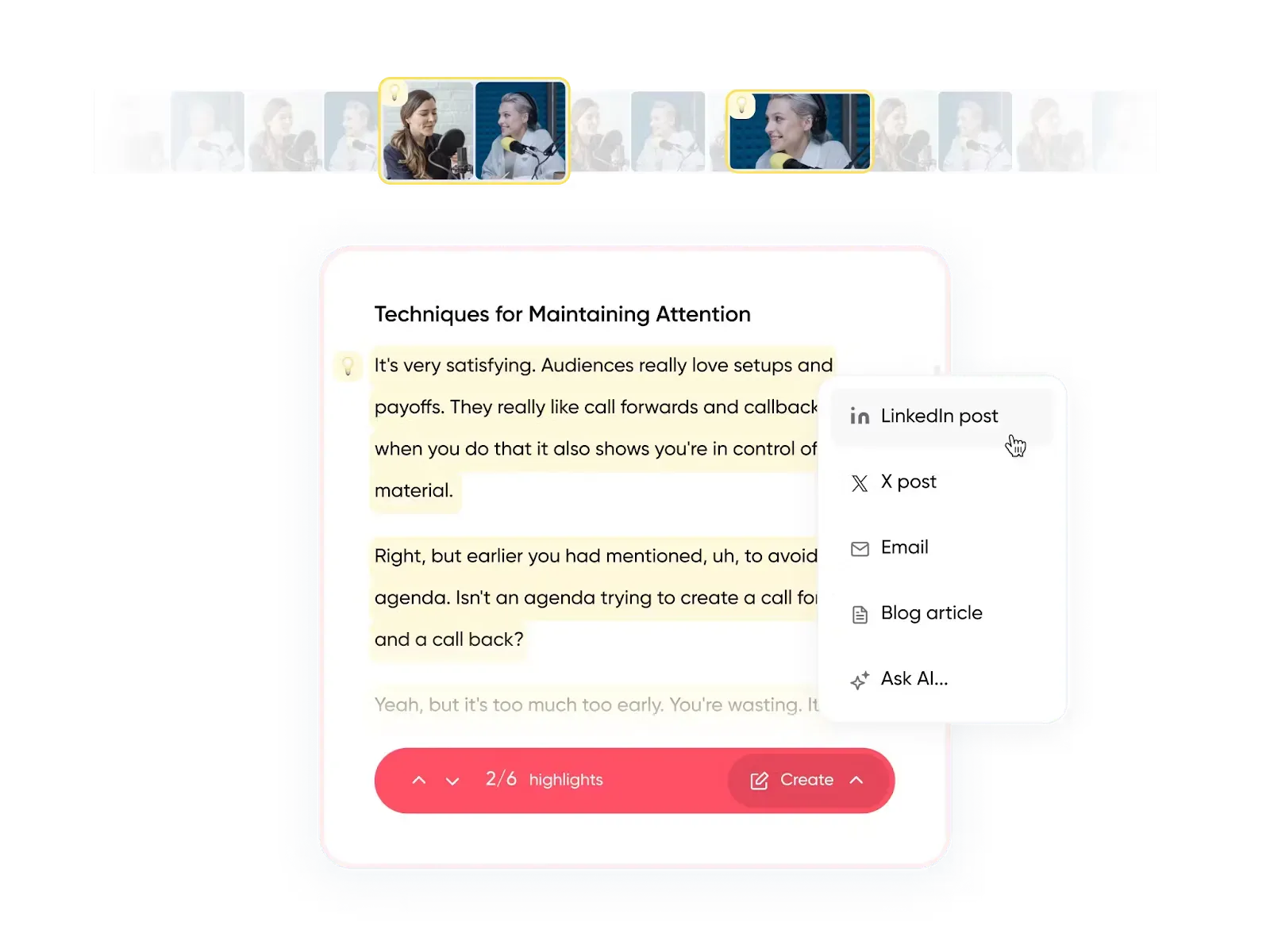
The alternative most teams are still running is the one Contrast's own team used before building this natively: rewatch the full recording, transcribe it separately, prompt a general-purpose AI tool by hand, then hand the video off to a different editing tool entirely to cut clips. Manually, a single "semi-decent" blog draft took about three hours; a genuinely good one took six. Multiply that by every format above and it's obvious why most webinar content never gets repurposed at all — not because it isn't valuable, but because turning one recording into a hub's worth of content used to be a half-day job.
Content hub examples: what this looks like running
Alleo's marketing team saves an estimated 4-6 hours per webinar by generating derivative content this way instead of building it manually — time that used to go into a single recap post now covers a blog article, clips and social copy for the same event. airfocus reports that roughly 65% of contacts whose first touchpoint is a Contrast webinar go on to become MQLs, a number that's hard to hit if the webinar's influence ends the day the live session does. And UserGuiding's Joud Ghazal described a smaller but telling data point: a single repurposed webinar clip picked up a subscriber who came back and watched it more than ten times — the kind of return engagement a one-off asset never gets a chance to earn.
None of these are hypothetical hub architectures. They're the same recurring pattern: one recorded session, cut into a dozen pieces, feeding the hub on a schedule the team doesn't have to think about every time.
Why AI-generated content needs a real transcript behind it
There's a specific reason a webinar-fed hub holds up better than a hub filled with generic AI-written filler, and it's not a branding argument. Ask a general-purpose AI model to write about "webinar best practices" and it produces a plausible, generic paragraph pulled from statistical patterns in its training data — no specific numbers, no named examples, nothing a reader couldn't get from a hundred other posts. Ask the same question against an actual recorded conversation with a named speaker's real numbers and anecdotes, and the output is specific by construction. It can't be generic, because it's grounded in something that actually happened.
That distinction matters more now than it did two years ago. AI answer engines increasingly cite sources with clear structure and verifiable specifics over generic web copy, and video content is disproportionately part of that mix: OtterlyAI's 2026 YouTube citation study found long-form video accounts for the large majority of AI citations pulled from YouTube, with structured, chaptered transcripts getting cited repeatedly across multiple answers instead of just once. A hub built from transcript-grounded content, with the original recording, chapters, and a written version all cross-linked, is structurally suited to that kind of repeat citation. A hub built from a dozen unrelated blog posts commissioned separately isn't.
Demand gen content hub: why the compounding matters more than the launch
The B2B buying journey is mostly self-directed research now, most buyers are somewhere between 70 and 80 percent through their own evaluation before they ever talk to a sales rep, according to buyer-behavior research from 6sense. A demand gen content hub exists to be found and read during that stretch, not after it. That only works if the hub is still growing by the time a prospect finds it.
This is where the repurposing-as-supply-chain model compounds instead of just multiplying once. A single webinar repurposed into ten pieces is a good week. A monthly webinar cadence repurposed the same way, every month, for a year, is 120 pieces of interlinked, transcript-grounded content — built without a bigger content team, a bigger budget or a separate editorial calendar.


Run this consistently and the hub isn't something you launch once and maintain. It's something your existing webinar program produces as a byproduct, every month, automatically feeding your broader webinar marketing strategy instead of sitting next to it as a separate initiative. It's worth checking your own numbers here too — Contrast's webinar benchmark data puts on-demand and replay viewing at well over half of total webinar views, which means most of your audience is watching after the live event, on whatever page you've put the recording on. If that page is just a recording with no derivative content around it, you're leaving most of the hub's potential value sitting in a single video player.
Where content hubs actually go wrong
Treating the hub as a launch project instead of a pipeline
A content hub built once and left alone loses to one that adds a cluster page every month, even if the initial version was smaller.
Filling gaps with generic AI content instead of grounded content
It's faster to ask a chatbot for ten blog post ideas than to mine an hour of transcript, but the output reads like everyone else's, because it's built from the same statistical patterns everyone else is pulling from.
Building the architecture before securing the supply
Pillar-and-cluster planning documents are easy to make and hard to keep fed. Confirm where the next twelve months of cluster content is actually coming from before finalizing the site structure.
Burying the source recording
If the webinar that a hub's blog post, clips, and newsletter were all drawn from isn't linked from a permanent, on-demand home, you've built five pieces of derivative content pointing at nothing.
Not closing the loop back to the original conversation
Repurposed content should drive people back to the source when they want more depth: that's what turns a single event into a growth engine rather than five disconnected posts.
Contrast: the webinar platform with repurposing built-in
Contrast helps marketing teams run webinar programs that feel modern and match their brand, with logos, colors and fonts. Onstream engagement features turn presentations into events the audience comes back to. Every interaction is tracked back into HubSpot, so that marketing and sales can follow up with the right message and person. When the session ends, AI gets to work: subtitled clips, a blog post, whatever you need next is there.
FAQ
What is a content hub?
A content hub is a structured collection of content organized around one core topic, typically anchored by a central pillar page linked to supporting cluster pages that each cover a specific angle or keyword variant. The structure signals topical authority to search engines and gives readers a reason to explore multiple pieces instead of one.
What's the difference between a content hub and a blog?
A blog is a chronological stream of posts; a content hub is organized by topic and internal linking, not publish date. A hub is built so that every piece connects back to a central page and to related cluster pages, while a typical blog archive has little structural connection between individual posts.
What's a good content hub strategy for a B2B company with limited content resources?
The most resource-efficient content hub strategy is repurposing an existing recurring content source — like a monthly webinar — into multiple formats instead of commissioning net-new content for every cluster page. This turns one recorded conversation into a pillar article, several cluster posts, video clips and social content without proportionally increasing headcount.
How often should a content hub be updated?
A content hub needs a consistent supply of new cluster content to keep growing, not a one-time launch. Tying hub updates to a recurring content source you already produce, a monthly webinar, a regular podcast, is more sustainable than relying on ad hoc commissioning.
Do content hubs still matter with AI search summarizing results directly?
Yes, and the format matters more, not less, because AI answer engines favor sources with clear structure and specific, verifiable detail over generic web copy. A hub built from real recorded conversations with named speakers and specific numbers is better positioned for AI citation than one built from generic, commissioned filler.
Can webinar content alone sustain a full content hub?
A recurring webinar program can sustain a meaningful hub on its own if each session is fully repurposed into a blog article, clips, social posts and newsletter content rather than left as a single recording. A monthly cadence repurposed consistently produces well over a hundred pieces of interlinked content a year from that source alone.