
Webinar Statistics 2026: 60 Stats You Need to Know


Webinars are on the rise. Businesses run more webinars than ever, and decision makers participate in them weekly. Here are 60 key stats to help you understand the trends and make smarter webinar decisions.
- How effective are webinars?
- What are the best days and times to host them?
- What's the best day to send your invitations?
Most webinar statistics are from the same old reports (2019-2023) — so we wanted to make our own report and include up-to-date statistics from our own data.
We'll answer all of these questions and more through these 60 research-backed webinar statistics so you can become a webinar pro.
How we collected the data
Our findings come from 3 sources:
Contrast platform data: Our team analyzed behavioral data from 1 million+ randomly selected webinar registrants on Contrast tracking registration patterns, attendance rates, engagement signals, drop-off points, and content consumption across thousands of webinars.
External marketer survey: We surveyed 524 B2B marketers actively running webinars to understand how they promote, measure, and evaluate their webinar programs. Respondents came from over 500 B2B SaaS companies of varying sizes and markets.
Third-party research: Where Contrast data doesn't cover a topic, we've incorporated findings from credible external sources. Each stat is attributed to its source directly below the headline.
Top 2026 Webinar Statistics
If you were to remember only a few webinar statistics, remember these:
- 91% of B2B professionals say webinars are their preferred type of content
- 42% of webinar views are on-demand (replay)
- 60-minute webinars have the highest average registrations
- Webinars with <100 registrants have 6% higher live attendance rates
- 24% of webinar registrations happen on Tuesdays
- 14% of webinar registrations happen the day of the webinar
- 87% of B2B Marketers use AI for their webinars and virtual events
- AI repurposing features save marketers over 16,000 hours and $800,000 a year


The best platform to make use of these stats
Contrast customers see higher engagement, attendance, and ROI
Book a demoWhat Makes Webinars Good for Marketing?
Webinars work well for marketing because they combine education, engagement, and lead generation in one format. They let you reach a targeted audience, build trust in real time through live interaction, and show your expertise instead of just talking about it. Plus, they’re cost-effective and easy to repurpose into other content, which makes them a high-impact channel for both acquiring and nurturing leads.
What is a Webinar?
A webinar is an online event (usually hosted by a company or business) broadcasted live on a given date and time. Most webinar tools let you create a registration page associated with your webinar, so your audience can sign up, get reminders, and receive a recording of the webinar.
During the live event, the host (and sometimes guest speakers) will interact with the audience using engagement features like Q&A, polls, and chat.
Why Run Webinars in 2026?
Webinars are still worth running in 2026 because they remain one of the most effective ways to generate high-quality leads, build trust, and drive conversions at scale.
They offer 3 main advantages:
- Lead generation: Marketers can use webinars to create and extend their email marketing audiences all while making sure that they are relevant contacts (because they are interested in the topic of the webinar). Webinars are powerful lead generation tools, both for increasing the number of leads and moving them down the funnel.
- Authenticity and engagement: Live webinars give hosts and speakers a platform to share their stories and experiences, which humanizes the brand. Audience members get the opportunity to engage with the brand, increasing stickiness and likelihood to buy.
- Repurposing: Marketers are often asked to "do more with less" in tough economic periods, and webinars are a great solution to this. Repurposing webinar content is a great way to increase content output: each webinar can become a blog article, a few social media posts, and short highlight clips.
If you're ready to implement these strategies, our complete webinar guide walks you through every step of the process.
Are Webinars Worth it in 2026?
Webinars are one of the most effective content formats for businesses in 2026, and the data proves it. Let’s dive into the numbers that show just how powerful webinars have become.
1. 91% of B2B professionals rank webinars as their favorite content format and more than 54% engage with them at least once a week
(Source: Ring Central)
Webinars aren't just effective, they're the preferred choice. The fact that over half of B2B professionals tune in weekly shows how important webinars have become to professional learning and buying decisions. If your audience includes B2B decision-makers, webinars aren't optional, they're expected.
What this means for you: If your B2B audience isn't being targeted with webinars, you're missing their preferred channel.
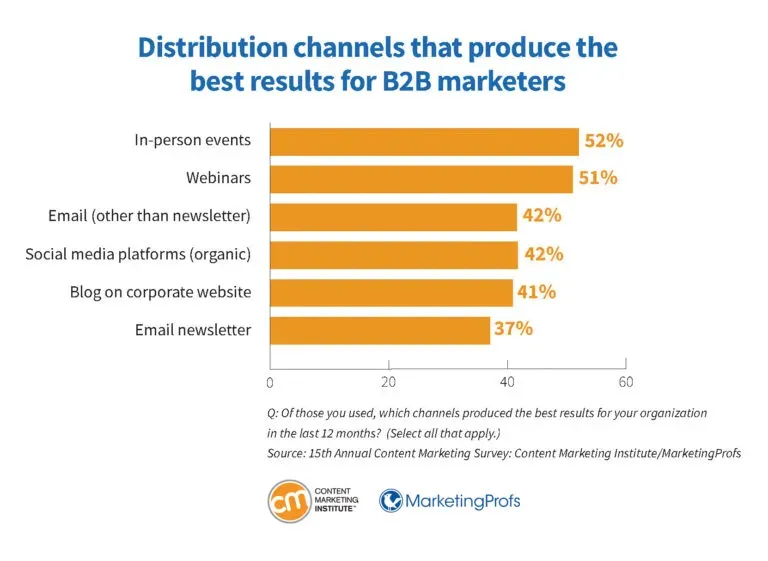
2. Webinars rank as the second most effective B2B content channel (51%), just behind in-person events (52%)
(Source: Content Marketing Institute)
The fact that webinars are only slightly behind in-person events shows that audiences still value personal connection and live experiences, and webinars provide a more convenient and cost-effective alternative. In-person events are way more expensive, logistically complex, and geographically limited.
What this means for you: The ROI gap between webinars and in-person events is massive. Webinars deliver nearly the same results at a fraction of the cost.
3. 73% of B2B marketers believe webinars yield the best high-quality leads
(Source: Martal Group)
73% of B2B marketers don't just rate webinar leads as "above average", they call them the best. This makes sense: webinar attendees self-select based on topic interest, invest their time, and often engage directly with your brand during the session. That level of commitment signals real buying intent.
What this means for you: Prioritize webinar lead quality over volume.
4. Nearly 63% of webinar attendees have made a purchase decision after attending a webinar
(Source: Martal Group)
Nearly two-thirds of webinar attendees have been influenced to make a purchase after attending a session. This makes webinars one of the most powerful conversion tools in B2B marketing not just for top-of-funnel lead generation, but for actively moving prospects all the way to a buying decision.
What this means for you: Add a clear, specific CTA at the end of every webinar.
5. 80% of people attend webinars for educational content
(Source: Martal Group)
This shows that most people join webinars to learn, not to be sold to. Audiences are looking for insights, practical knowledge, and expert perspectives, which means overly salesy webinars can easily turn them off.
What this means for you: Lead with value. If your webinar is more than 20% product talk, you're losing your audience.
6. Webinars are in the top 3 most effective channels for thought leadership content
(Source: Content Marketing Institute)
Webinars rank third out of all content channels for establishing thought leadership. LinkedIn dominates at 76%, then we have email newsletters at 54% and webinars at 52%. The reason webinars work so well for thought leadership is the live, unfiltered nature of the format. Audiences can evaluate not just what is being said, but how it’s being said, how confidently speakers handle complex topics, respond to unexpected questions, and engage in real-time discussion. This creates a level of authenticity and credibility that polished, pre-written content can’t fully replicate.
What this means for you: Treat every webinar as a thought leadership asset, not just a lead gen tool. The credibility it builds compounds over time.
General Webinar Statistics
Let's cover some high-level statistics about the webinar market:
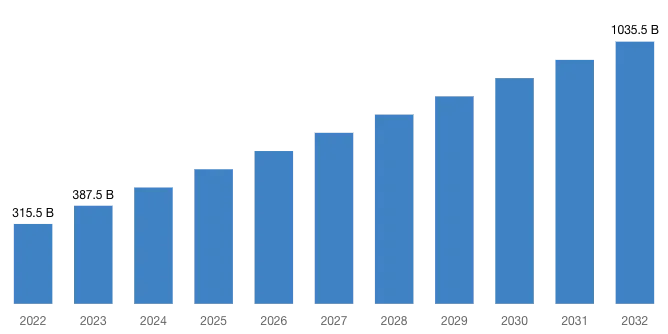
7. The global webinar and virtual event market will hit $1 trillion by 2032
(Source: Custom Market Insights)
The virtual events industry is absolutely exploding right now. The market is expected to hit over $1 trillion by 2032 – that's a 14% growth rate year over year.
What's really interesting is that this isn't just leftover momentum from the pandemic. Companies have discovered that virtual events work incredibly well for reaching global audiences without the massive costs and logistical headaches of traditional events. People can join from anywhere, businesses save on venue and travel expenses, and you get better engagement data.
What this means for you: As the space grows, competition will increase, so simply hosting webinars won’t be enough. You’ll need to focus on quality, differentiation, and delivering real value to stand out.
8. 77% of webinar revenue comes from North America followed by India and Brazil
(Source: Affiliate Booster)
America still dominates the webinar scene, bringing in over three-quarters of total revenue. In India and Brazil webinars are super popular but are used more for learning and building interest rather than direct sales. So you end up with a lot of engagement there, but less revenue compared to North America.
What this means for you: Treat this as a benchmark, not a rule. If your audience is in North America, you can expect stronger revenue potential from webinars. But if your target audience is in other regions, don’t judge performance against this stat. Experiment with different formats, offers, and goals, and focus on what actually works for your audience.
9. 58% of B2B marketers use webinars as a promotional tool
(Source: Content Marketing Institute)
Webinars are actually converting prospects into qualified leads at a much higher rate than other marketing channels. When you can showcase your expertise, demonstrate your product, and interact directly with potential customers all in one session, it makes sense that webinars have become such an effective lead generation machine.
What this means for you: More than half of B2B marketers already use webinars as part of their promotional mix. If your competitors are running webinars and you aren't, you're ceding a channel that 58% of the market has already adopted.
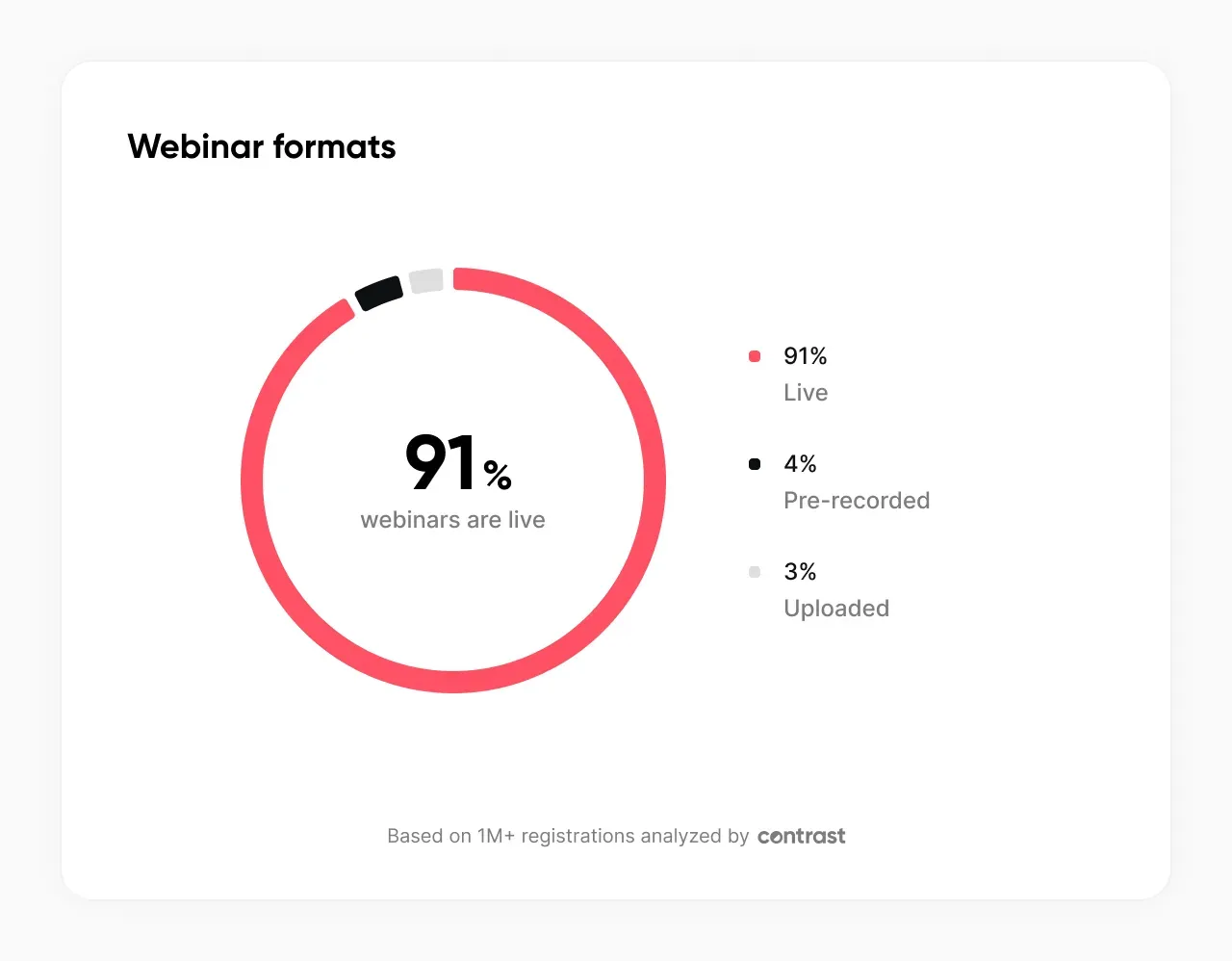
10. 91% of webinars are delivered live
(Source: Contrast)
This shows that webinar hosts strongly prefer live formats because they can interact directly with their audience, answer questions immediately, and create a more engaging experience.
Only about 4% of webinars are simulive, where the entire session is pre-recorded and presented as if it’s happening live. Meanwhile, around 3% of webinars incorporate short pre-recorded videos during the live session. These videos are usually demo clips or related content, while the majority of the webinar remains live.
What this means for you: Live webinars are still the standard for a reason. But that doesn’t mean everything has to be live. You can still use pre-recorded elements (like demos or segments) to improve quality, as long as the overall experience stays interactive.
Webinar Registration Statistics
What are the days of the week with the most registrants? How long should your webinar be? What prevents people from registering to your webinars?
Let’s explore the key data points that reveal how to maximize your webinar registrations.
11. The average audience member registers for 2 webinars per year
(Source: Contrast)
On average, each person registers for about 2 webinars per year. This shows that attendees are interested enough to come back for more than just one session, making webinars an ongoing part of their learning or engagement.
What this means for you: Think beyond single events and focus on creating a consistent webinar series that keeps your audience coming back.
12. The average attendee watches 2 of your webinars per year
(Source: Contrast)
Over the last year, people watched an average of 2 webinar sessions on Contrast—the same number they registered for. This shows that when webinars deliver quality, engaging content, audiences stay committed and keep coming back.
What this means for you: Every webinar is a chance to earn the next one. Make your CTA the next session.
13. The top 10% of webinars attract 288+ registrants
(Source: Contrast)
The best webinars don't just attract an audience, they attract the right one. Here's how registration numbers break down across the board:
- The average webinar attracts 128 registrants
- Top 25% of webinars attract 138+ registrants
- Top 10% of webinars attract 288+ registrants
- Top 5% of webinars attract 454+ registrants
- Top 1% of webinars attract 956+ registrants
What this means for you: Don't benchmark yourself against 128 if you're just getting started. Reaching 138+ registrants means you're outperforming 75% of webinars out there. Focus on attracting the right people over maximizing raw sign-ups, and use those thresholds as goalposts as you scale your webinar program.
14. Webinar registration page conversion rate can be up to 59%
(Source: Contrast)
Webinar registration page conversion rates can reach up to 59% with Contrast. That’s nearly double the average reported by Livestorm — just 30%. While results depend heavily on traffic quality, Contrast pages consistently outperform.
The quality of your webinar registration page can have an impact on the total number of people who register and their conversion rates to live attendees. Webinar landing pages have substantially higher average conversion rates than your typical landing page (10%).
What this means for you: Your registration page is a conversion asset. Invest in its copy, design, and load speed.
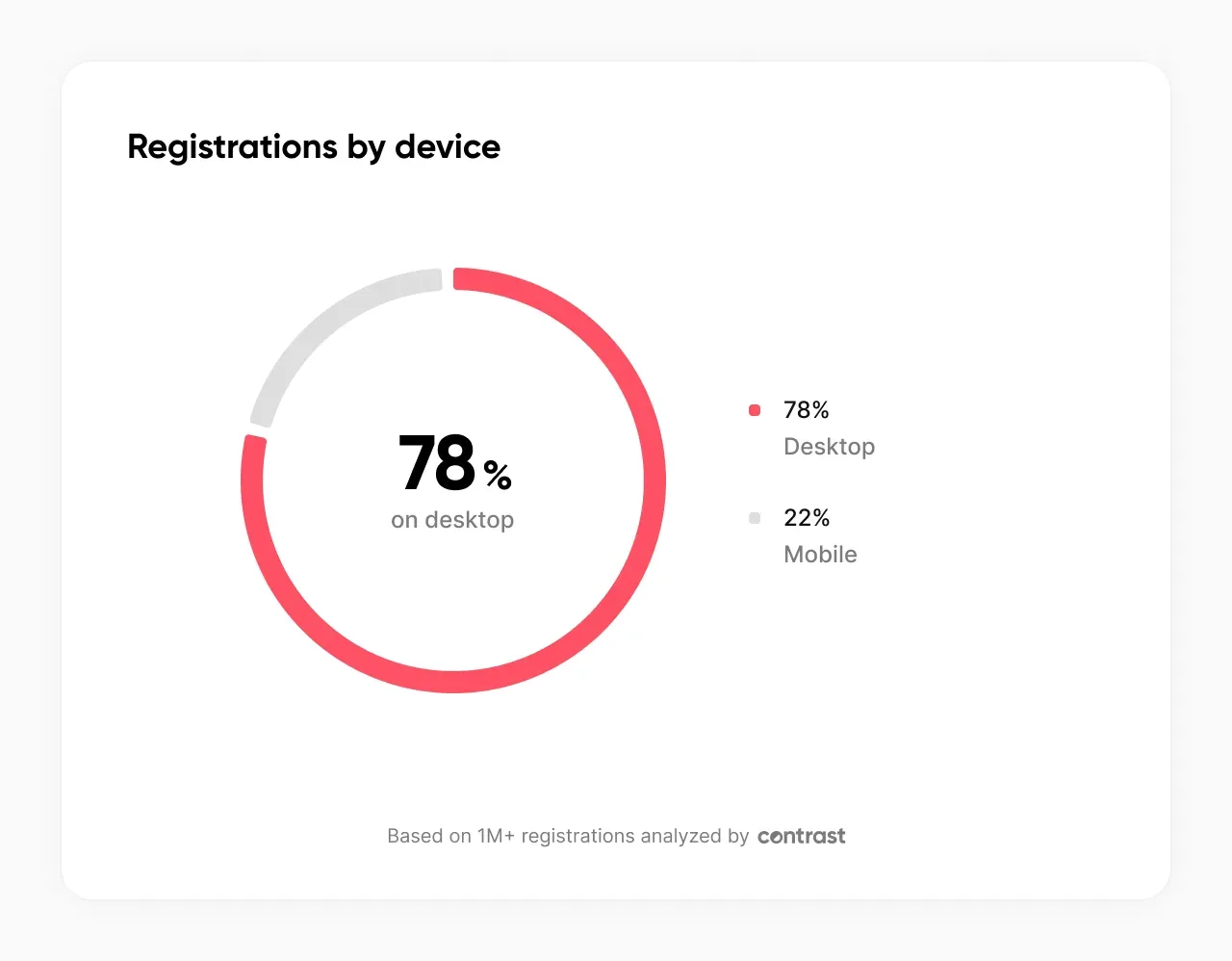
15. 78% of webinar registrations come from desktop
(Source: Contrast)
Even though most people sign up on desktop, 22% are registering through their phones. That’s a big enough chunk to make sure your registration page works well on both mobile and desktop. A simple, fast, and mobile-friendly design can help boost sign-ups and keep the process smooth for everyone.
What this means for you: Optimize for desktop first, but test your registration page on mobile before every campaign.
16. 79% of webinar signups happen via email
(Source: Contrast)
Most people prefer using email to register for webinars, with 79% choosing it over SSO, which only accounts for 21%.
The 79% email preference likely comes down to simple user interface and habit. When people see a registration form, they automatically default to the familiar "enter your email" field rather than looking for or clicking an SSO button. It's also possible that many users are on devices/browsers where they're not already logged into their work accounts (most of the webinars require work emails).
What this means for you: Most people (79%) will naturally default to signing up with email instead of SSO, so don’t overcomplicate the flow.
17. 71% of webinar hosts use the built-in signup page
(Source: Contrast)
Most webinar platforms let you choose between using their built-in signup pages or connecting an external form, like HubSpot. You should look for a tool that integrates seamlessly with your CRM, so you can avoid manual CSV uploads and keep your workflows flowing effortlessly.
What this means for you: It’s important to choose a webinar platform that lets you create high-converting registration pages while also integrating smoothly with your CRM.
Contrast lets you create high-converting registration pages while seamlessly connecting everything to your CRM, so leads are captured, tracked, and synced automatically.
18. Thursday webinars have the highest average registrations
(Source: Contrast)
The stats show that Thursdays are probably the best day to run your webinar. Thursday pulls in about 8% more registrants than Tuesday and roughly 16% more than Wednesday. This likely comes down to timing. By Thursday, people have settled into their week, caught up on work, and are more open to signing up for something extra, while earlier days are often too busy and midweek fatigue hasn’t fully hit yet.
What this means for you: Schedule your most important webinars on Thursdays to maximize total sign-ups.
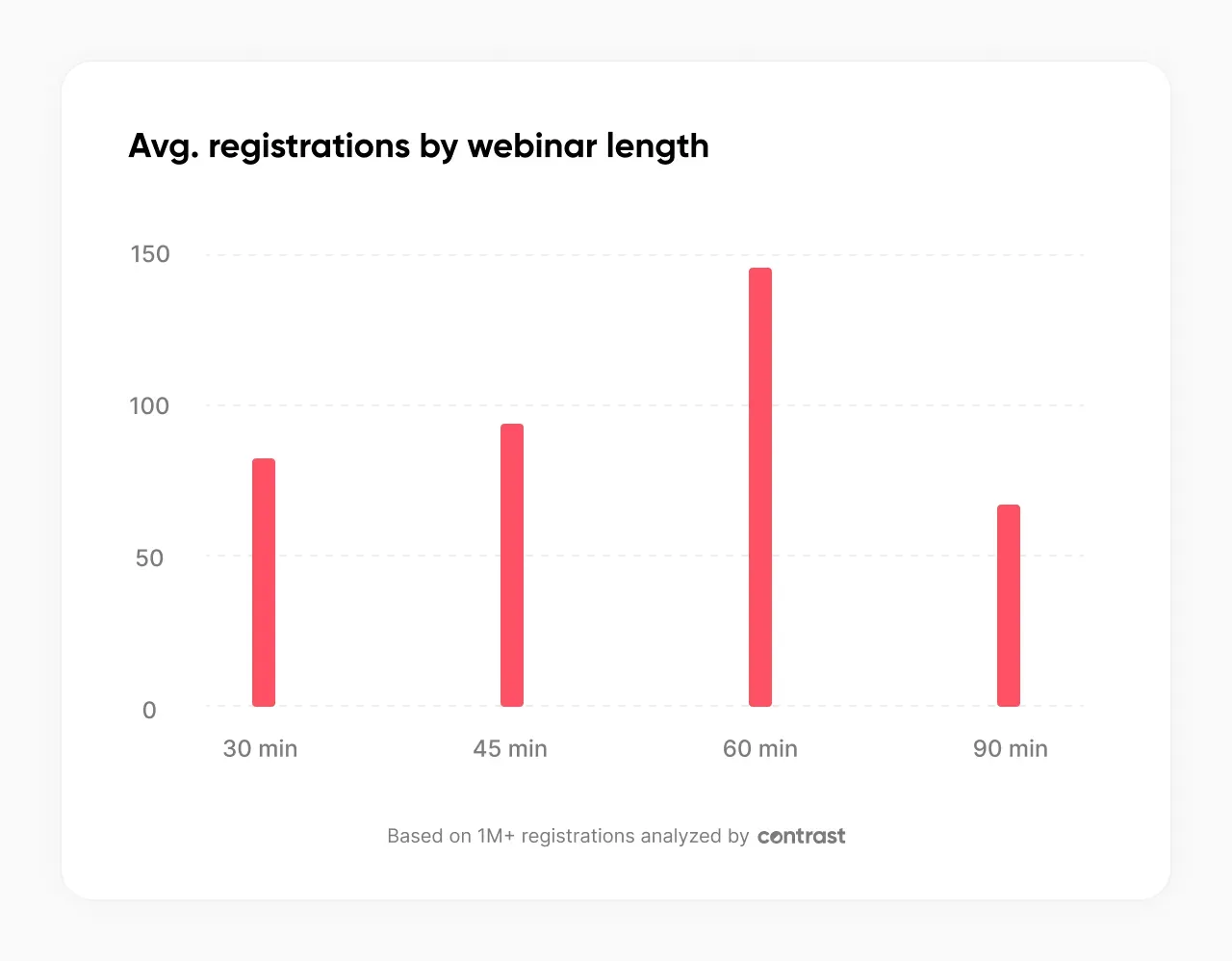
19. 60-minute webinars have the highest average registrations, followed by 45-minute, then 30-minute sessions
(Source: Contrast)
Consistent with last year's finding that 60-minute webinars dominate registrations. The order remains unchanged: 60 minutes leads, followed by 45-minute and 30-minute sessions, with 90-minute webinars trailing on registrations despite their strong live attendance performance.
This suggests that people are actually willing to commit more time if the topic feels valuable. Shorter webinars (30-45 mins) can feel easier to attend, but they don’t always promise enough value to stand out.
What this means for you: Default to 60-minute webinars as your baseline format, since they consistently attract the most registrations.
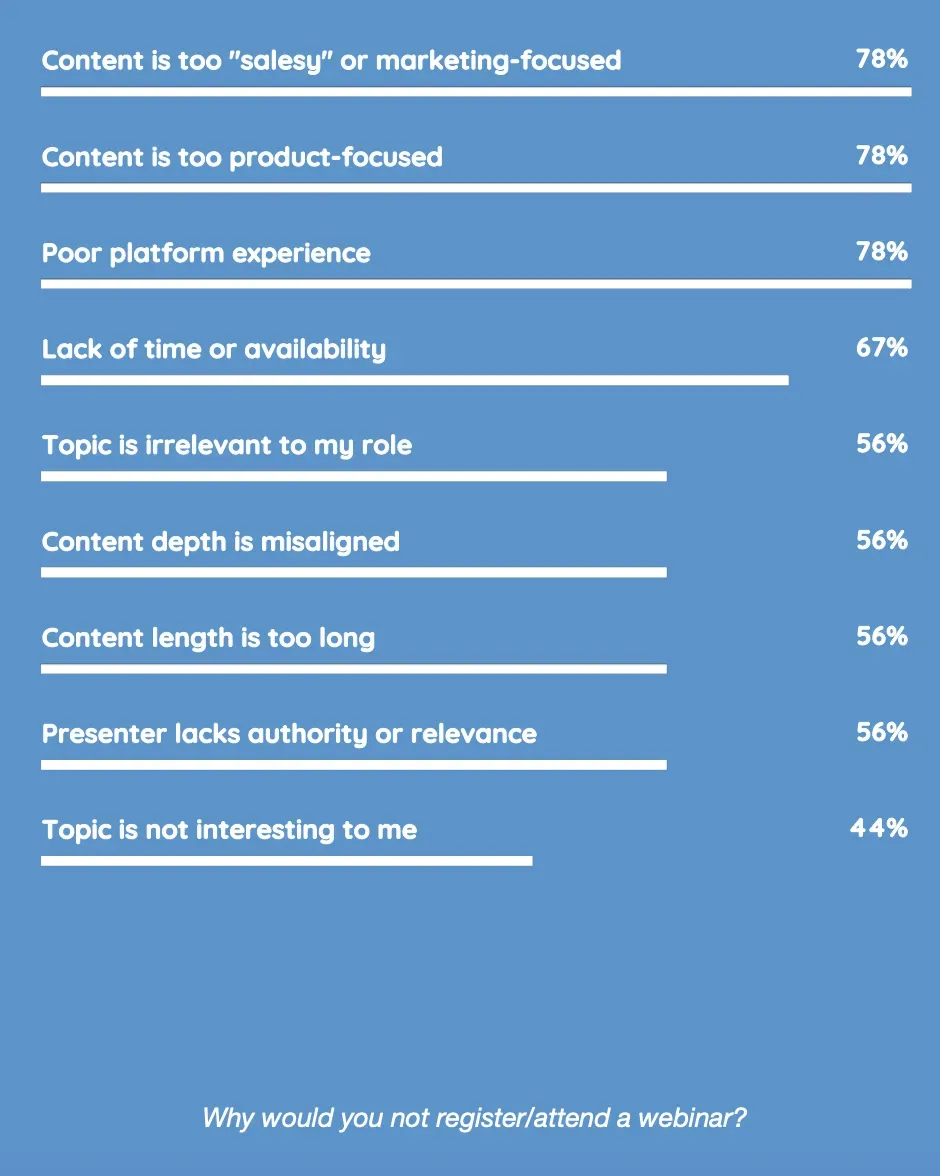
20. 78% of people would not register to a webinar that looks too "salesy" or marketing-focused
(Source: BrightTALK)
Other common reasons for not wanting to register to a webinar are: content is too product-focused (78%), or poor platform experience (78%). Make sure your content is aligned with your audience and you're using a modern webinar platform.
What this means for you: Audit your registration page copy. If it reads like a sales pitch, rewrite it around the audience's problem.
21. Email marketing is the best channel for registrations, ads are the worst
(Source: Contrast - External Survey)
We did an external survey of 524 B2B SaaS marketers to find out which channels they use to promote their webinars and which drive the highest-quality leads.
Here are the results: 94% use social media posts, 86% marketing emails, 56% newsletters, 46% website banners, 38% LinkedIn DMs and 25% communities to promote their webinars. However, when asked which channels drive the most high-quality leads, marketing emails dominated with 91% of respondents naming them as their top-performing channel, while newsletters (20%), website banners (18%), LinkedIn DMs (16%), and paid ads and communities (11%) were mentioned considerably less often.
This is further validated by external research from Affiliate Booster showing that 73% of all webinar registrations come directly through email invitations and reminders — making email not just the most effective channel, but the primary driver of webinar sign-ups overall.
What this means for you: Audit your webinars and track which channels are actually driving your best registrations and leads. Then double down on the channel that performs best for you.
22. Webinars with guest speakers drive more registrations
(Source: Contrast - External Survey)
Guest speakers appear to be a significant factor in webinar success.
Almost half of marketers (45%) invite a guest speaker to every webinar, and 21% do it often but not for all webinars. That means most webinars feature voices outside their own company.
34% of webinars feature only internal speakers, which often comes across as too scripted or overly sales-focused. When it's just company voices, audiences quickly lose patience with "us talking about us" narratives.
On the other hand, webinars with guest speakers get 3 times more engagement. That’s because outside experts bring fresh ideas, credibility, and real conversations that audiences want to hear. Plus, guest speakers help you tap into their networks, expanding your reach beyond your existing audience.
What this means for you: Don’t rely only on internal speakers. Bring in guest experts whenever possible.
Everything you need to get more webinar sign-ups
Build modern, branded, high converting registration pages with Contrast
Book a demoWebinar Engagement Statistics
Now lets look at the webinar engagement statistics that you can use to improve your webinar strategy:
23. 61% of registrants watch the webinar (live or replay)
(Source: Contrast)
On average, nearly 6 out of 10 registrants watch Contrast webinars. Frictionless user experiences, automated reminders and follow-ups, automatic on-demand webinars and AI repurposing features all increase content consumption.
What this means for you: Getting people to register is only half the job, you also need to focus on getting them to actually watch. So, build strong reminder sequences, make replays easily accessible, and repurpose your webinar into on-demand content so more registrants end up engaging with it.
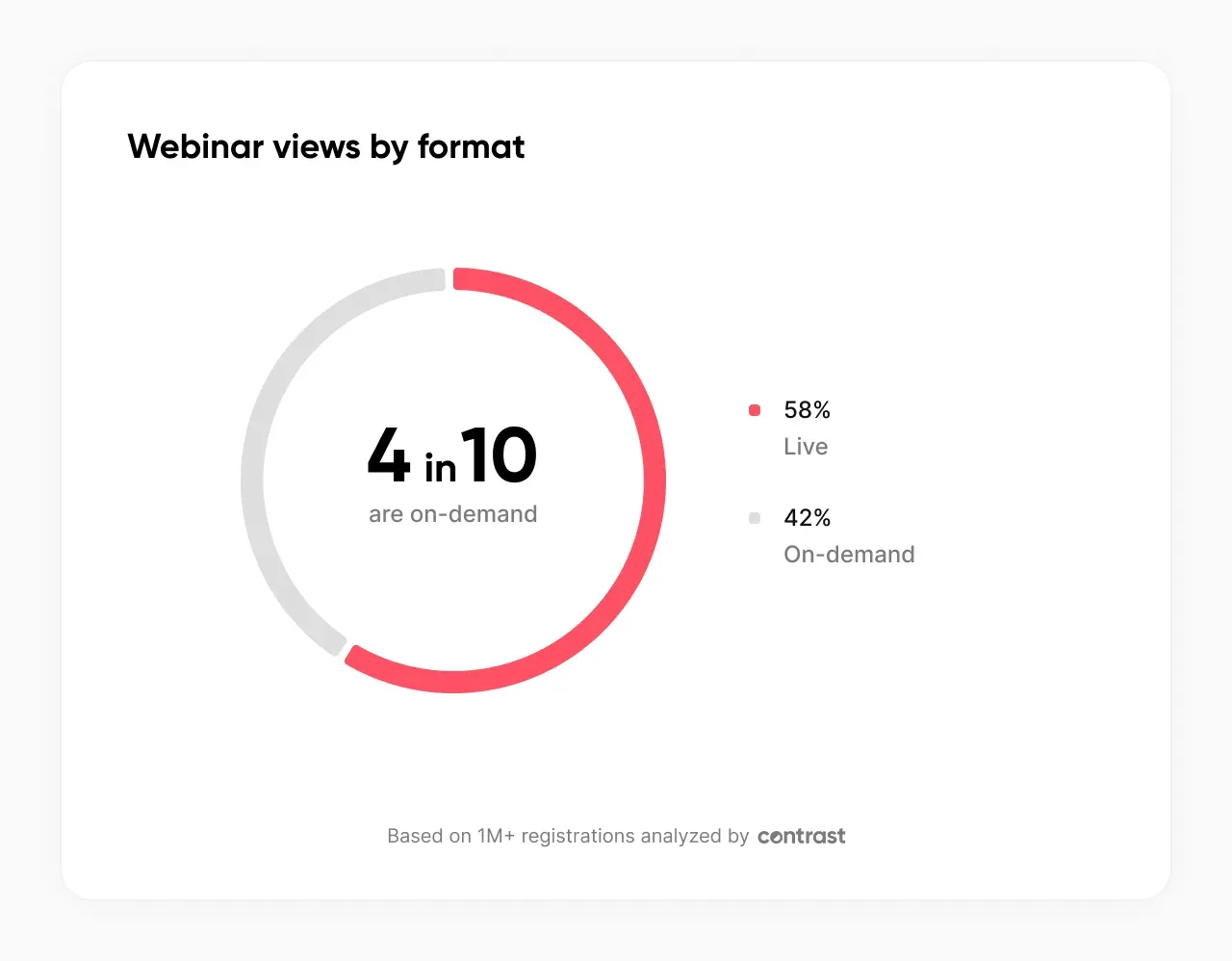
24. 42% of webinar views are on-demand (replay)
(Source: Contrast)
Down from 47% last year, suggesting a slight recovery in live attendance. This could reflect improved promotion strategies and better reminder sequences encouraging more registrants to attend live. But still, nearly half of your total viewership (42%) comes after the live event, making on-demand availability and follow-up content essential parts of your webinar strategy.
What this means for you: Make sure your replay is easy to access, promote it just like the live session, and follow up with registrants so you continue getting value even after the event ends.
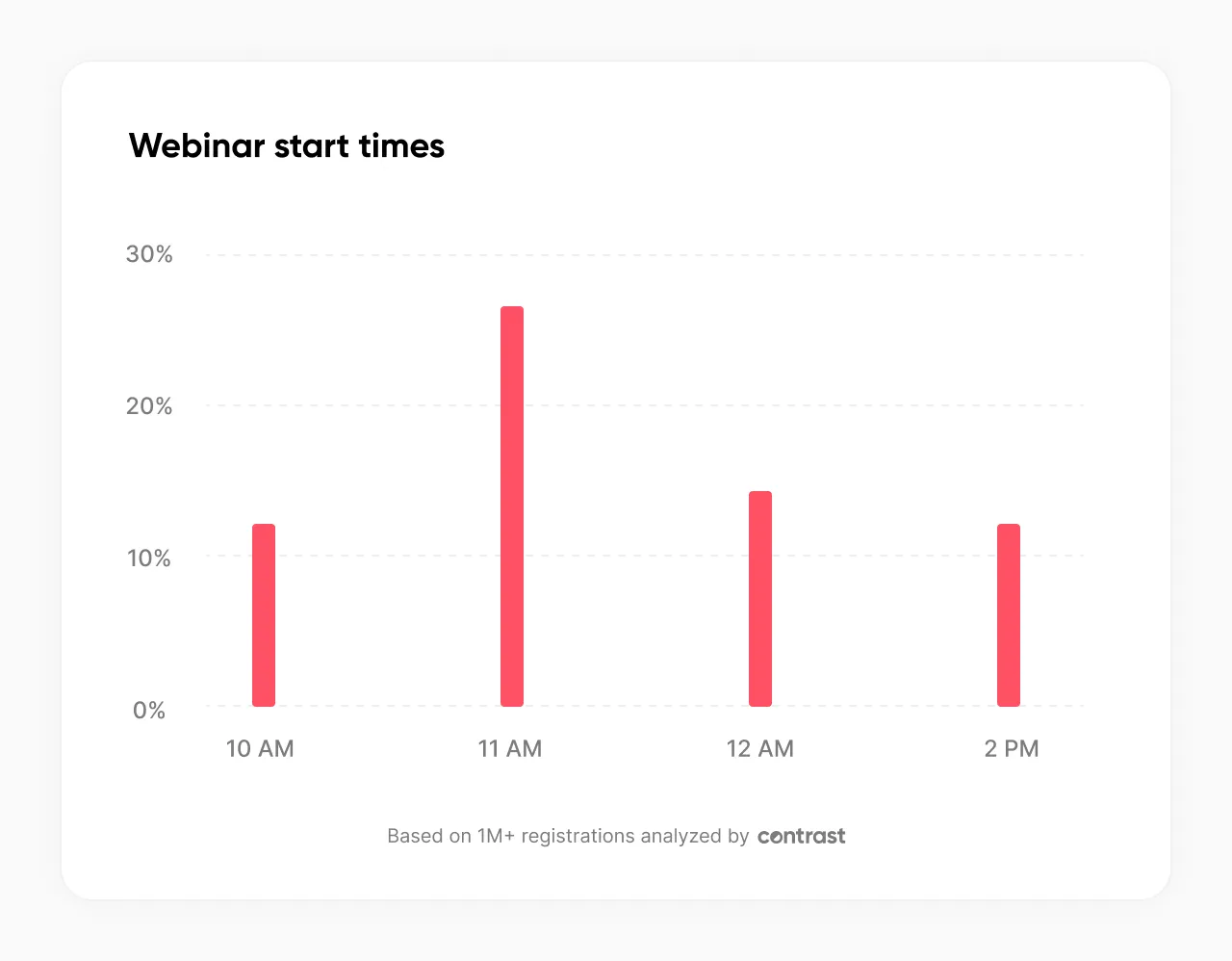
25. 27% of webinars happen at 11AM local time
(Source: Contrast)
Most webinars (27%) happen at 11AM local time. After that, attendance spreads out fairly evenly across 12PM (12%), 10AM (11%), and 2PM (11%), showing that mid-morning to early afternoon is generally the most convenient window for live participation.
What this means for you: Schedule your webinars in the mid-morning to early afternoon window, with 11AM as the safest starting point since it consistently performs best. Then test around it (10AM, 12PM, or early afternoon) to find what works best for your specific audience.
26. 46% of webinars use live polls
(Source: Contrast)
Polls are a great way to interact with your audience but only 46% of webinar hosts use live polls to engage their audience – though this number has increased by 20% from 2 years ago.
What this means for you: Add at least one poll to your next webinar. It takes 2 minutes to set up and measurably improves engagement. Learn about how you can use poll responses in your webinar follow up here.
27. The average number of poll responses is 32
(Source: Contrast)
Polls are a great way to learn more about your audience, but also to qualify them. Those 32 responses represent your most engaged attendees, the ones who are invested in your content and willing to interact.
What this means for you: Don’t just use polls for engagement, use them as a way to identify your most interested attendees. Even if only around 32 people respond on average, those are your warmest leads.
28. The top 5% of webinars get 47% poll completion rate
(Source: Contrast)
The best webinar hosts run a poll every half an hour (30 mins). Which for a 1h webinar is 2 polls on average. People complete them 47% of the time. Hosts that show polls on-stage get 15% more completions than hosts who don't.
What this means for you: Run one poll every 30 minutes and display it on-stage.

29. 92% of webinar attendees say the end of your event must include a live Q&A session.
(Source: Truelist)
This statistic really highlights how audiences have moved beyond passive consumption – they want to engage, ask questions, and get real-time responses from presenters. It makes perfect sense when you think about it: after sitting through a presentation, people naturally have questions or want clarification on specific points.
What this means for you: Always end your webinar with a live Q&A session. You can also turn the questions you get into an FAQ or even future content, so the value continues after the webinar ends.
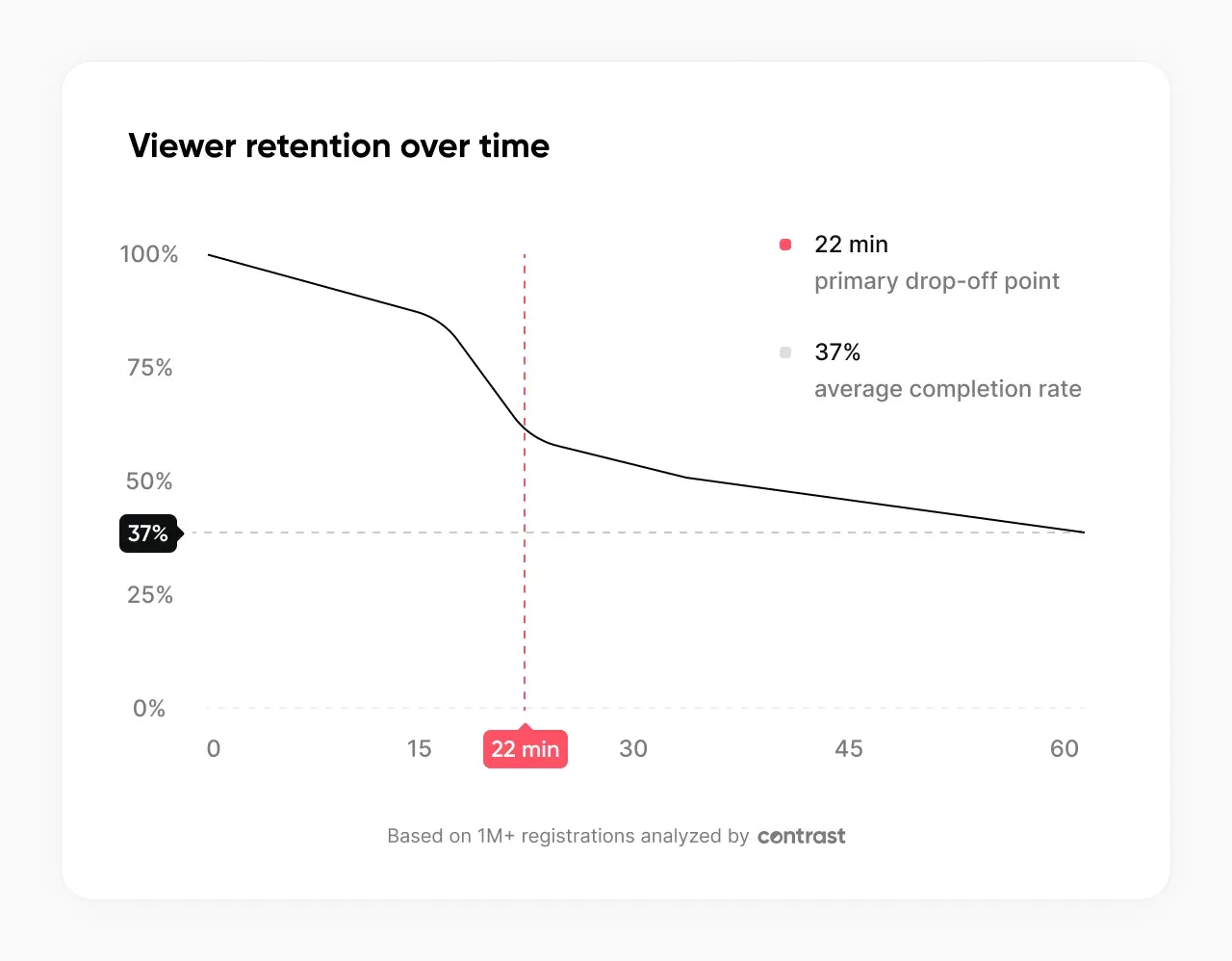
30. Webinar viewers drop off at the 22-minute mark on average
(Source: Contrast)
This aligns with research on typical professional attention spans and with the natural transition point between a webinar's opening context-setting and its core content delivery.
Why 22 minutes? By this point, viewers have heard your intro, your speaker credentials, and your agenda. If they haven't experienced a compelling insight, an interactive moment, or a clear signal of what's coming next, they're likely to leave. It's also the point where competing priorities like Slack messages, emails, other meetings tend to win back their attention.
What this means for you: Place your most engaging content just before the 22-minute mark. It can be a surprising data point, a live poll, a provocative question, or a compelling case study. Structure your webinar in clear segments and preview upcoming content at the 15-20 minute mark to give viewers a reason to stay.
Want to run more engaging webinars?
Have a Contrast expert walk you through ways to get more engagement out of your audience
Book your demoWebinar Attendance Rates and Benchmarks
Increasing your webinar attendance rates is an easy way to increase your webinar ROI. So what's the best way to do so?
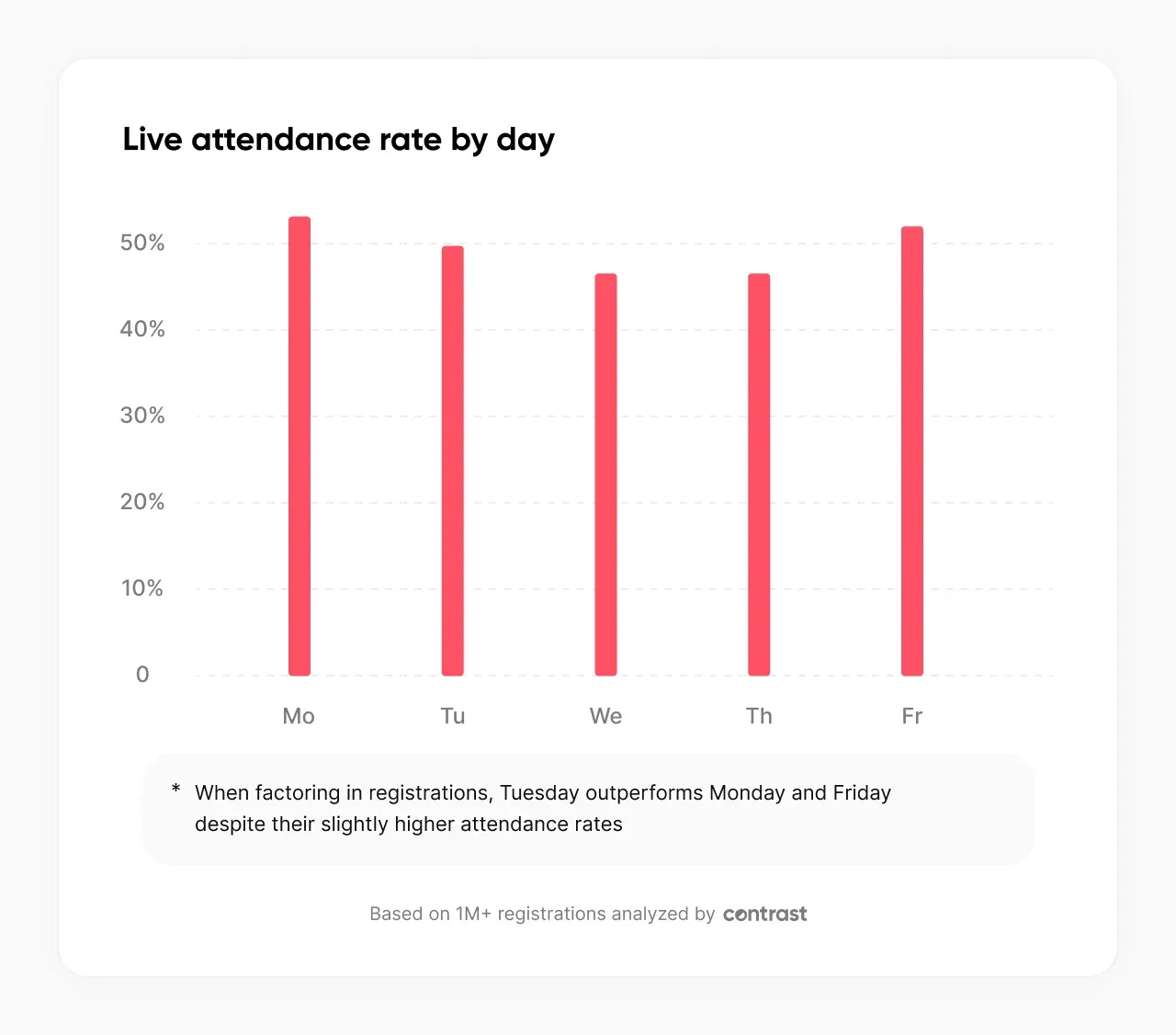
31. Tuesdays are the best day for live attendance at 50%
(Source: Contrast)
Tuesday is your best bet for live attendance, with a 49.71% attendance rate, making it the most reliable day for webinar performance.
Mondays (53.26%) and Fridays (52.02%) do post slightly higher raw attendance rates. But those days attract far fewer registrations (see stat 45), so a higher attendance rate doesn't tell the whole story.
Think of it this way: a 52% attendance rate on 100 registrations gives you 52 live attendees. A 50% attendance rate on 1,000 registrations gives you 500. Tuesday consistently delivers that larger registration base, so even a marginally lower attendance rate translates to a significantly bigger live audience.
When you combine strong registration volume with a near-50% attendance rate, Tuesday pulls ahead as the clear winner for total live viewers.
What this means for you: Tuesday is your safest bet for predictable, high-performance webinars. Wednesday and Thursday are solid backups. Monday and Friday attendance rates may look appealing on paper, but lower registration volume means fewer people actually show up on the day.
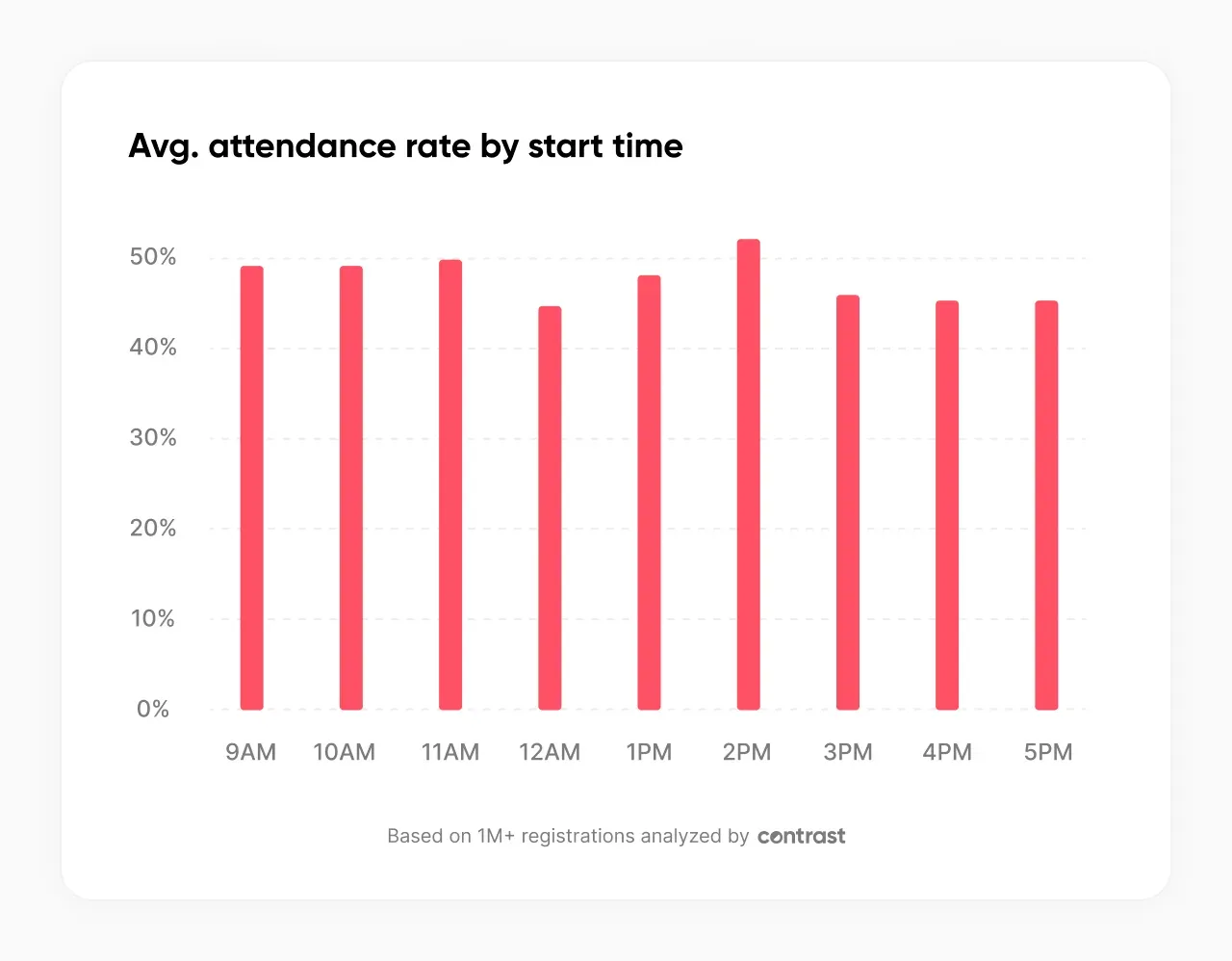
32. Webinars at 2PM have the highest average attendance rates (55%)
(Source: Contrast)
The timing sweet spot for webinars is 2PM at 55%, followed closely by 11AM at 50% and 10 AM at 49%. Most 2PM webinars are scheduled in CET, which translates to 8AM EST, giving American audiences a chance to join during their morning hours.
Conversely, 11AM EST webinars work perfectly for European participants who can attend at 5PM CET, right at the end of their workday.
What this means for you: If you're running global webinars, test 2PM CET. It covers both EU afternoon and US morning audiences in one slot.
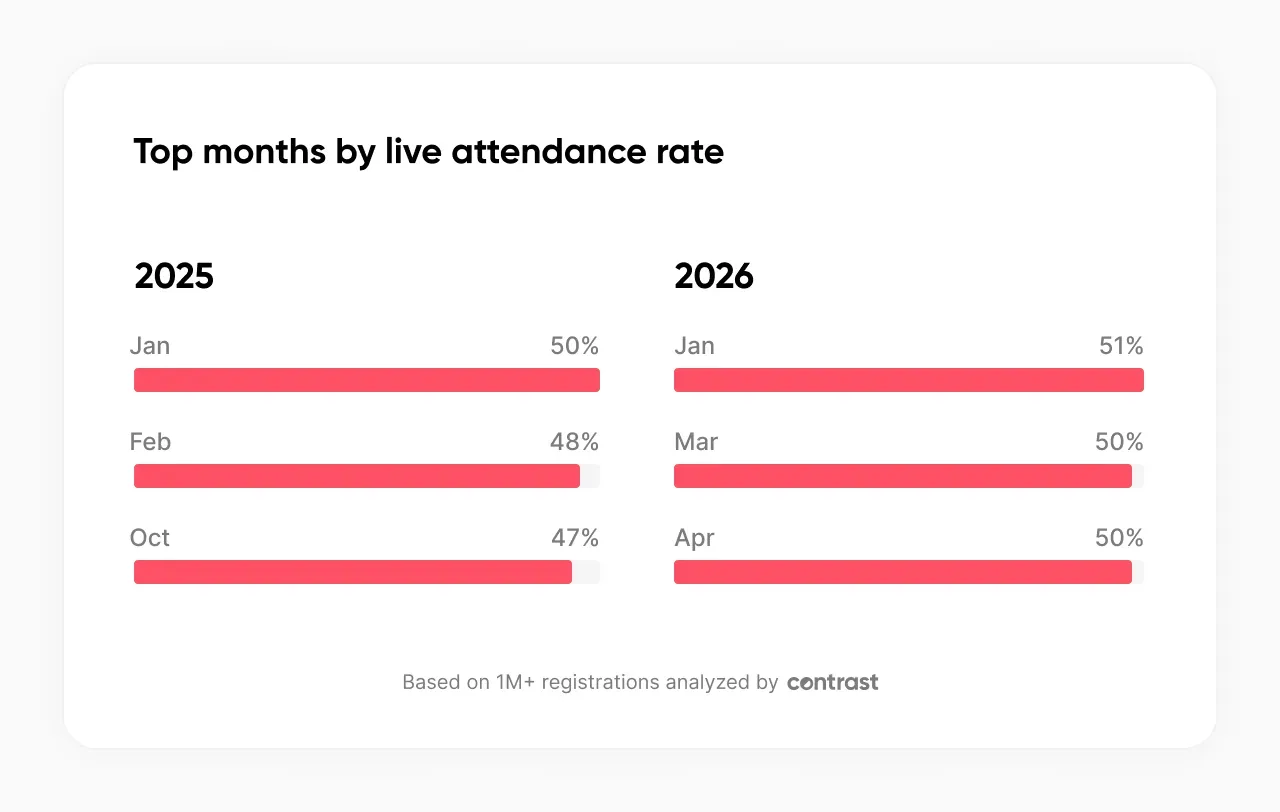
33. January is the month with the highest average live attendance rate (51%)
(Source: Contrast)
January is still the strongest month for live webinar attendance at 51%. It's followed closely by March and April both at 50% and February at 47%.
Compared to last year, where February (48%) and October (47%) ranked highly after January, this year’s data shows more concentrated peak in Q1, with stronger consistency in early-year attendance overall.
What this means for you: Plan your most important webinar of the year for January. Your audience is at peak motivation.
34. 90-minute webinars have 23% higher live attendance rates than 30-minute webinars
(Source: Contrast)
Webinar duration significantly impacts live attendance rates, with 90-minute webinars achieving the highest attendance at 67%. This is followed by 45-minute webinars at 49%, 60-minute sessions at 47%, and 30-minute webinars at 44%. When people sign up for 90-minute webinars, they’re more likely to show up and stick around. It shows that if someone commits to a longer session, they’re probably really interested in the topic.
What this means for you: Longer webinars tend to attract more committed attendees, so don’t be afraid of 90-minute sessions if the topic is deep enough.
35. The average completion rate for a 60-minute webinar is 37%
(Source: Contrast)
On average, 37% of viewers stay for the entire 60-minute webinar. That means while many are engaged, a good number drop off before it’s over. This shows how important it is to keep things interesting throughout.
What this means for you: You need to actively design your webinar to hold attention from start to finish. Adding polls, Q&A sessions, or interactive moments can help hold attention and keep people watching until the end.
Q&A on stage with Contrast
36. Webinars with fewer than 100 registrants have 6% higher live attendance rates
(Source: Contrast)
Smaller webinars tend to be more targeted and relevant to the audiences. This increases live attendance rates. They also get 10% more views. Running more, smaller webinars can be a great way to increase webinar engagement.
1000+ registrant webinars have the lowest average attendance rates at 37%, while those with 100-1000 registrations perform better at 44%.
What this means for you: Instead of always chasing big numbers, consider running more focused sessions for specific audiences.
37. 82% watch webinars on desktop, 18% on mobile
(Source: Contrast)
We already talked about how important it is to optimize your registration page for both mobile and desktop, especially since 78% of registrations come from desktop and 22% from mobile. The same goes for the viewing experience.
While 82% of attendees watch webinars on desktop, 18% still tune in from their phones. That’s nearly 1 in 5 viewers and out of 1M+ registrants that we analyzed, that’s a significant number. So even though desktop is the primary screen, making sure your webinar platform works smoothly on mobile is just as important for reaching your full audience.
What this means for you: Test your webinar on mobile before every session.
38. 67% of registrants who don't show up say they forgot or got too busy
(Source: EntrepreneursHQ)
This is a new and important data point for understanding no-shows. The good news: forgetting is entirely solvable. A well-structured reminder sequence can solve this. The data on reminder sequences (check out stat 54) confirms that hosts who send three reminders see 27% higher live attendance rates.
What this means for you: Send 3 reminder emails: Day before, one hour before, five minutes before. Also adding a calendar invite link in your confirmation email, the moment when registrants are most excited about the event, is one of the highest-leverage, lowest-effort tactics you can use.

Zefort boosted event attendance by 79%
See what drove the numbers — and how to replicate it
Learn moreWebinar Conversion Rates and ROI: What Actually Drives Results
Based on survey data from 524 B2B marketers actively running webinars, we analyzed the metrics and content strategies that separate high-performing programs from the rest. Here is what the data shows on webinar conversion rates, ROI, and which content formats are delivering the best results.
39. Educational sessions generate 53% more ROI than product demo webinars
(Source: Contrast - External Survey)
While thought leadership webinars are the most popular format (85% of marketers run TL webinars), educational sessions deliver the highest ROI.
Value-driven content consistently outperforms sales-focused presentations. Educational sessions work because attendees leave with immediately applicable knowledge, creating natural progression from learning to buying.
What this means for you: Restructure your webinar content around your audience's learning goals, not your product features.
40. Customer story webinars rank second in ROI effectiveness
(Source: Contrast - External Survey)
Customer story webinars also deliver high ROI, ranking second among all webinar formats despite being run far less frequently than other formats (only 18% of marketers run customer story webinars).
These sessions work so well because they show your product in action through real customers, giving prospects both proof and relatable stories at the same time. People trust people, and when they see someone like them winning with your product, it makes buying feel like the obvious next step.
What this means for you: If you're not running customer story webinars, start. They're the most underused, overperforming format in your toolkit.
41. Webinars with clear CTAs see 25% more conversions
(Source: EntrepreneursHQ)
These two statistics reinforce each other. Webinars with clear CTAs see 25% more conversions, and attendees who engage with Q&A, polls, or chat are 30% more likely to convert.
What this means for you: Use strong, well-placed CTAs throughout your webinar and especially at the end, and combine them with interactive elements like polls and Q&A to keep people engaged. The more involved your audience is, the more likely they are to convert.
CTA on Contrast
42. 35% of marketers reported their biggest challenge is proving ROI to stakeholders
(Source: Contrast - External Survey)
We all face challenges when running webinars. Out of 524 marketers 38% reported their biggest struggle is promoting the webinar. Proving ROI to stakeholders comes next, mentioned by 35%, and that often happens because their webinar data isn’t properly integrated with their CRM.
What this means for you: Connect your webinar platform to your CRM. Without that link, you can't show the ROI to stakeholders.
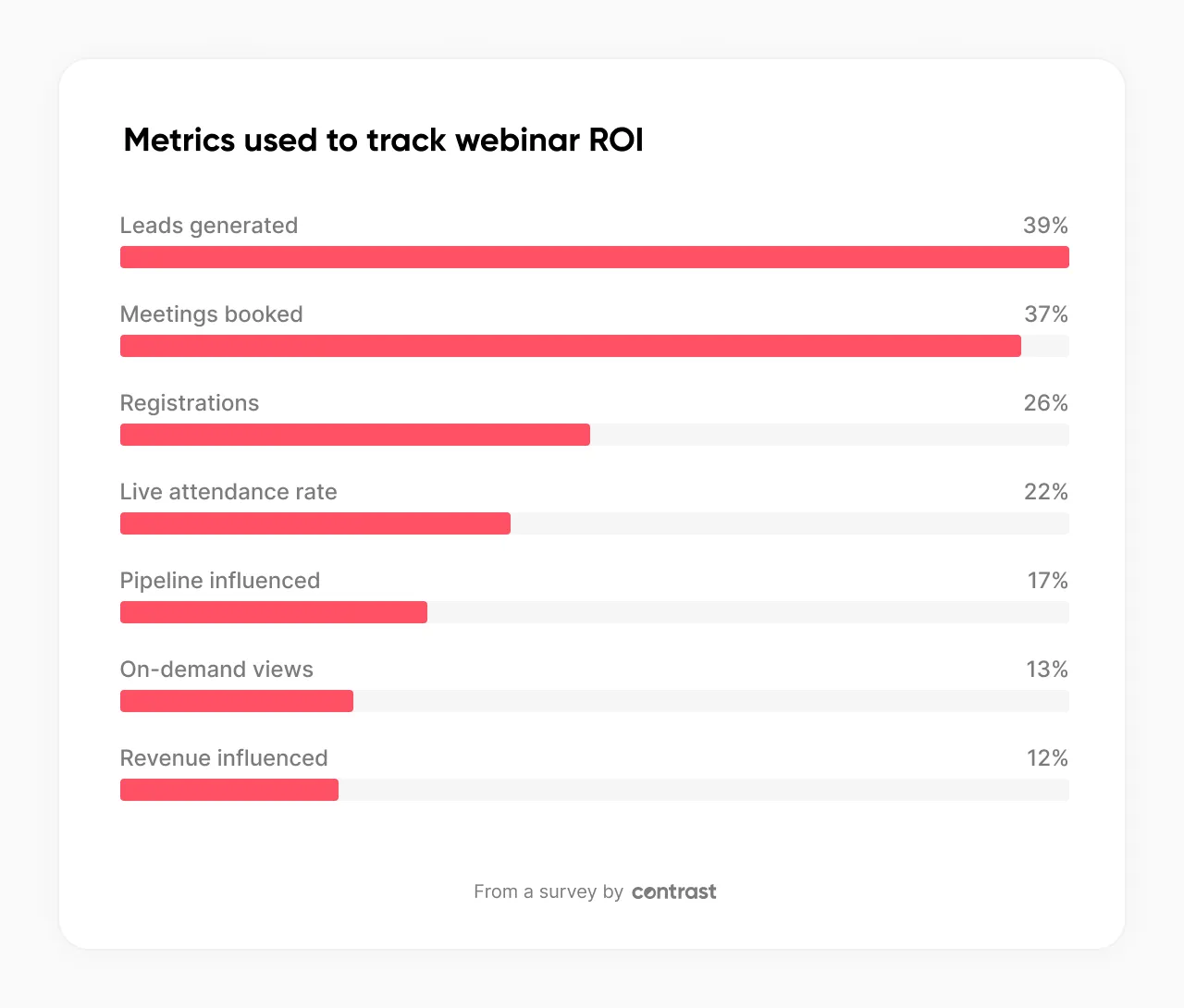
43. 39% of marketers track leads as their primary webinar metric
(Source: Contrast - External Survey)
Almost 40% of marketers track leads generated as their main webinar metric because leads offer immediate, easy-to-measure results. However, only 17% track how webinars influence pipeline, and just 12% measure their actual impact on revenue. This gap in deeper measurement helps explain why “proving ROI to stakeholders” is the second biggest challenge marketers face.
What this means for you: Add pipeline influence tracking to your webinar reporting. Leads alone don't show the true impact.

Turn webinars into measurable revenue
Integrate webinar data with your CRM and see what’s really driving ROI
Book a demoWebinar Marketing Statistics
These webinar statistics will help you improve your webinar promotion efforts:
44. Marketers host a webinar every 21 days
(Source: Contrast)
Companies typically host webinars every 21 days, which works well for keeping audiences engaged without overwhelming them. This cadence shows that most organizations use webinars as part of their ongoing marketing and education efforts, not just as occasional events.
What this means for you: Build a content calendar around a 3-week webinar cadence. It keeps you top of mind without burning out your audience.
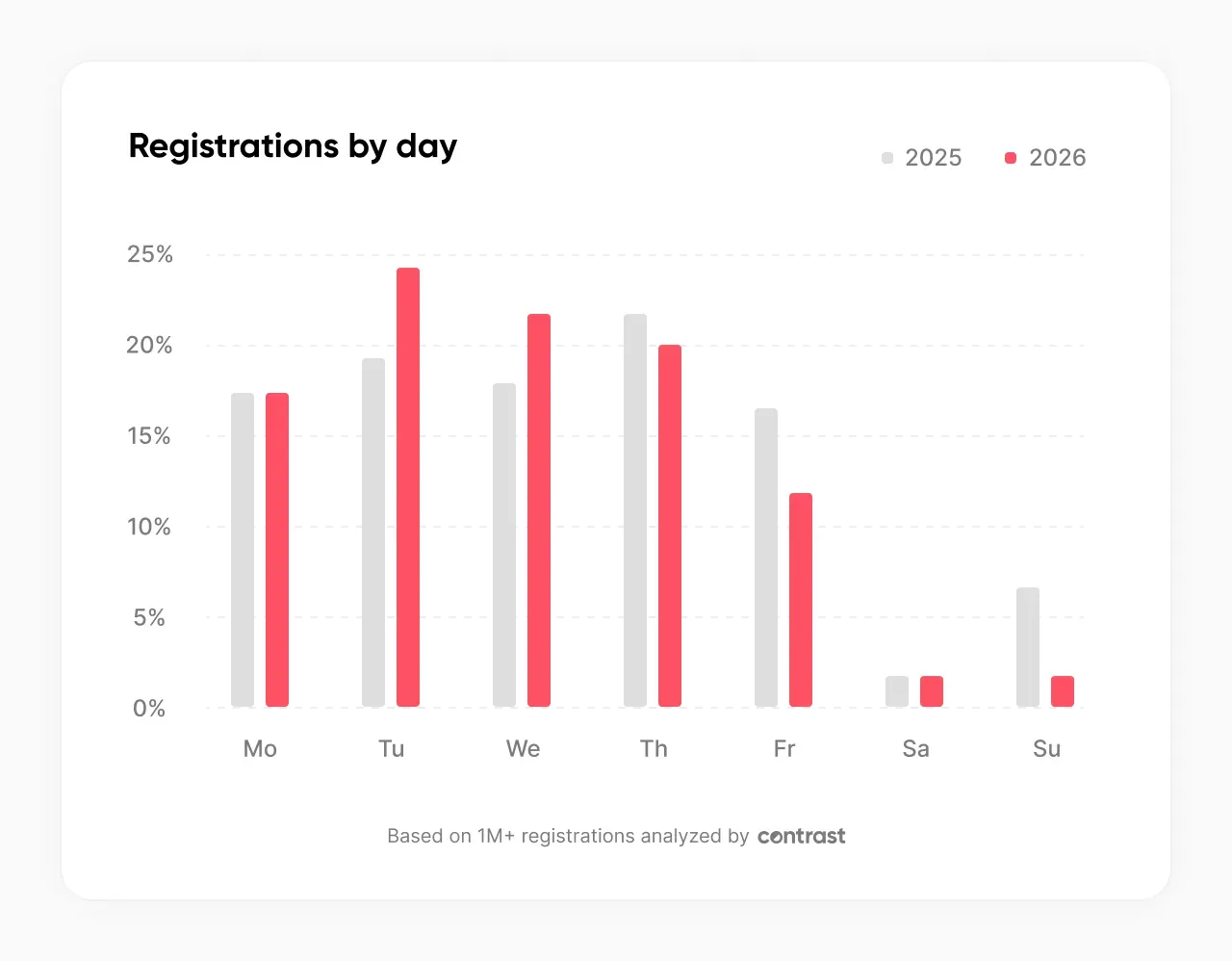
45. Most registrations happen on Tuesdays (24%)
(Source: Contrast)
There is a notable change from last year here, when Thursday held the top spot at 22%. Tuesday is now the best day to send your webinar invitations. This shift aligns well with email marketing engagement patterns. Tuesday is consistently one of the highest-performing days for email open and click rates. Wednesday (22%) and Thursday (21%) remain strong alternatives.
Note: Thursday webinars still attract the most registrants per event (Stat 18). This metric refers to the day of the week when registration clicks are most likely to happen.
What this means for you: Send your promotional emails on Tuesday. It's when your audience is most likely to click and register.
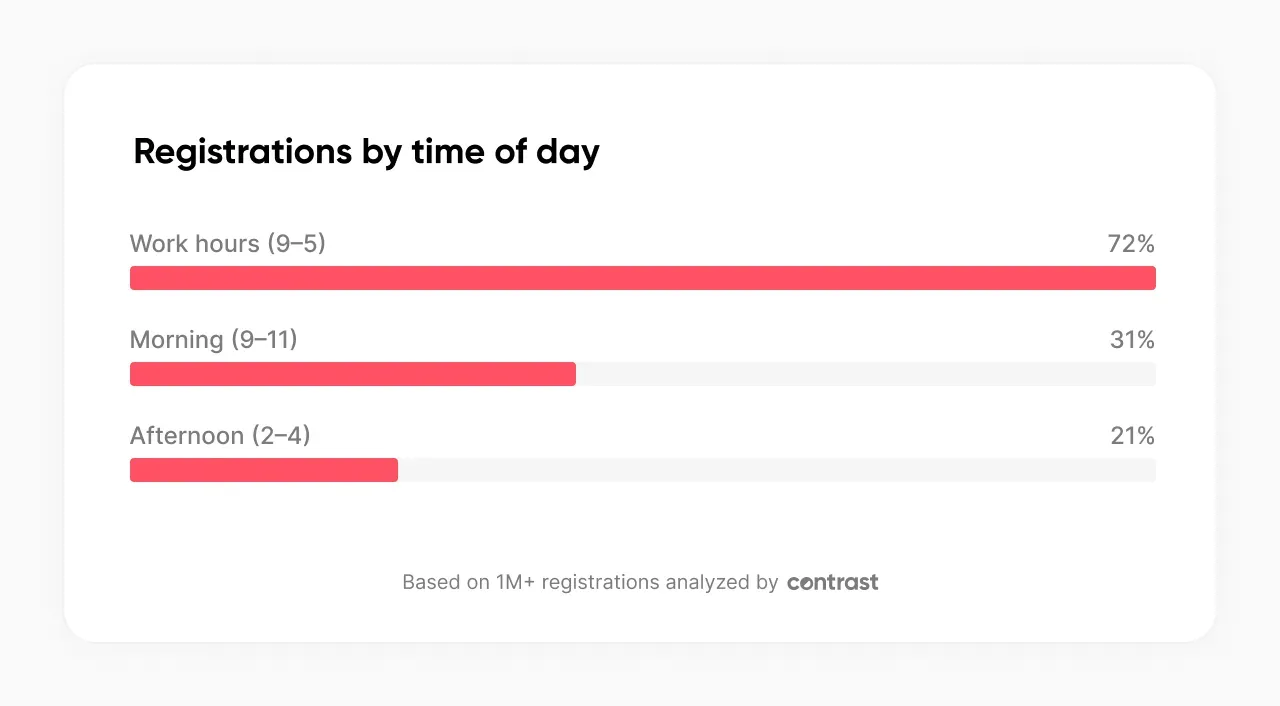
46. Market your webinar between 9AM and 5PM local times
(Source: Contrast)
72% of registrations happen between 9AM and 5PM local times. 31% of registrations are between 9AM and 11AM and 21% of registrations between 2PM and 4PM.
What this means for you: Schedule your email sends for 9AM or 5PM local time. These are your highest-conversion windows.
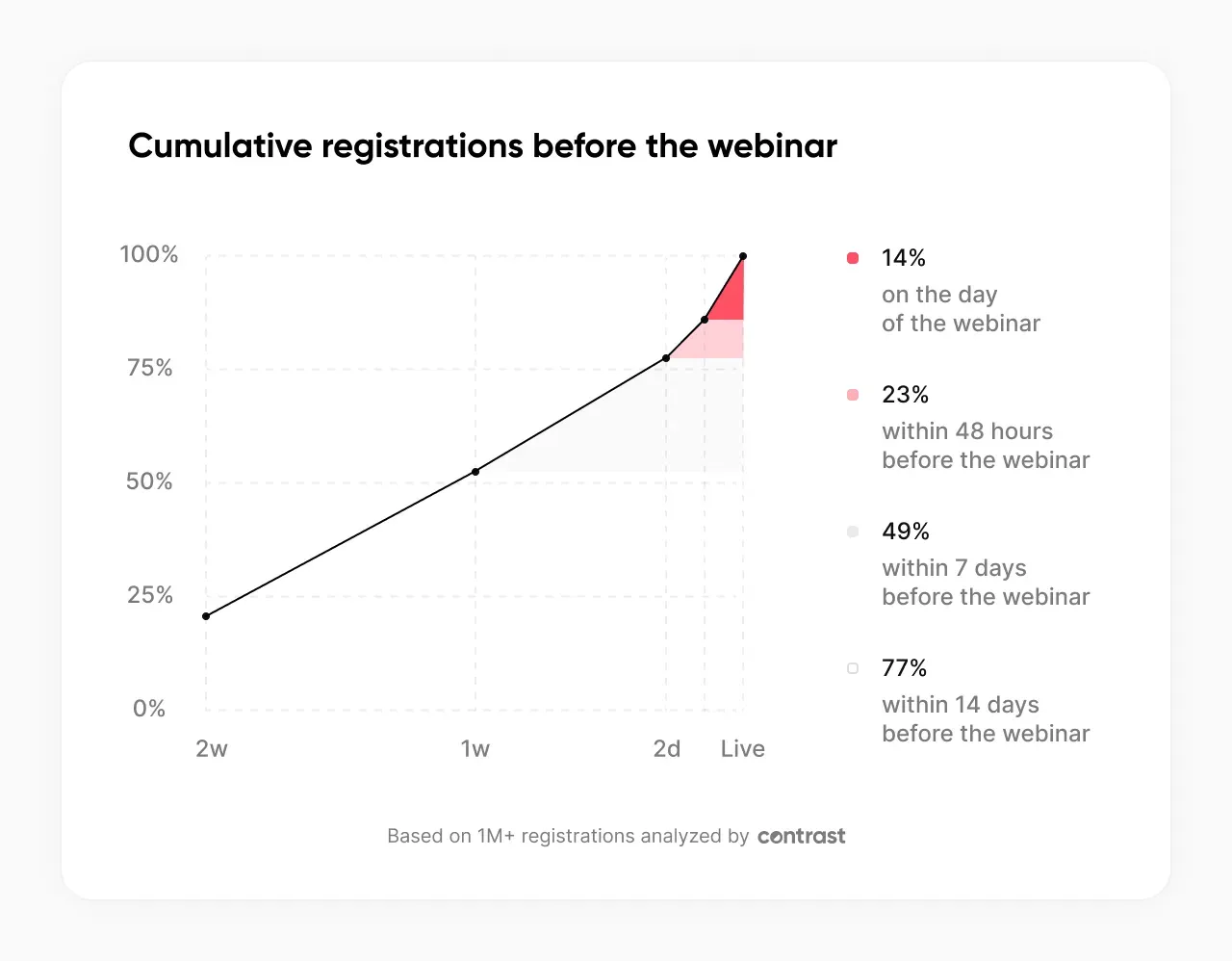
47. 49% of webinar registrations happen <7 days before the event
(Source: Contrast)
Almost half of all webinar registrations happen in the week before the webinar goes live. 77% of registrations happen in the 2 weeks before the event goes live. Only 3% register more than 4 weeks out. This means your most intensive promotion push should happen in the final week.
What this means for you: Don’t front-load all your promotion. Your biggest push should be in the final 7 days, when almost half of all registrations happen.
48. 14% of webinar registrations happen the day of the webinar
(Source: Contrast)
Don't stop marketing your webinar until you go live, people will sign up until the last few minutes. 23% of registrations happen within the 48 hours before the webinar goes live.
What this means for you: Keep promoting on the day of your webinar.
49. 50% of marketers start webinar promotion more than 4 weeks in advance
(Source: Contrast - External Survey)
Most marketers plan their webinar promotion well ahead of time, with half starting more than 4 weeks before the event and 48% beginning 2 to 3 weeks prior. Only a small number (2%) wait until the final week to begin promoting. This early start is important for building awareness and giving people time to plan to attend.
What this means for you: Start early for awareness, but save your most compelling emails (promotional materials) for the final week when intent is highest.
50. 57% of webinar hosts are using UTM parameters to track their webinar marketing campaigns
(Source: Contrast)
This shows that marketers are getting smarter about attribution and measuring what actually drives registrations. UTM tracking for webinars allows you to see exactly which channels, campaigns, and content pieces are bringing in your best attendees.
What this means for you: Tag every promotional link with UTM parameters. Without them, you can't know what's driving your registrations.
51. Only 16% of marketers still use the word "webinar" in their event titles
(Source: Contrast)
This makes complete sense from a marketing psychology perspective - "webinar" has become somewhat stale and corporate-sounding, potentially turning off audiences who associate it with dry, sales-heavy presentations.
What this means for you: 83% of marketers are instead opting for more engaging language like "masterclass," "workshop," "live training," "demo," or "virtual event" to make their sessions sound more valuable and interactive.
52. 91% of marketers apply custom branding to their webinars
(Source: Contrast)
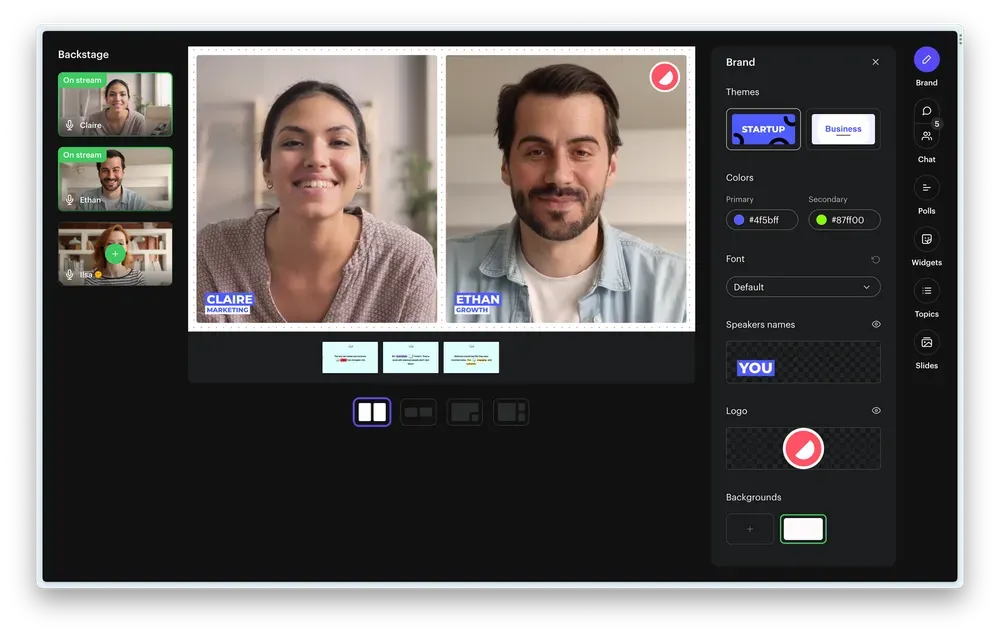
Webinars are often a prospect's first real interaction with your company, so maintaining consistent visual identity through logos, colors, and branded templates creates a professional impression and reinforces brand recognition.
What this means for you: Use consistent visuals, colors, and templates so every touchpoint feels professional and reinforces your brand, especially since this might be someone’s first real interaction with your company.
53. 77% of marketers integrate webinar data with their CRM
(Source: Contrast)
This has slightly increased from 75% last year to 77% this year, showing steady progress in how marketers connect webinar data to their CRM systems. Common integrations are with HubSpot, Salesforce or automation tools like Zapier, Make, or Webhooks or APIs. This stat shows that teams are getting better at tracking leads properly and linking webinar engagement directly to pipeline activity, which improves both reporting accuracy and sales visibility.
What this means for you: If your webinar data isn't in your CRM, make that integration your next priority. Everything else depends on it.
54. Webinar hosts send an average of 2 reminder emails
(Source: Contrast)
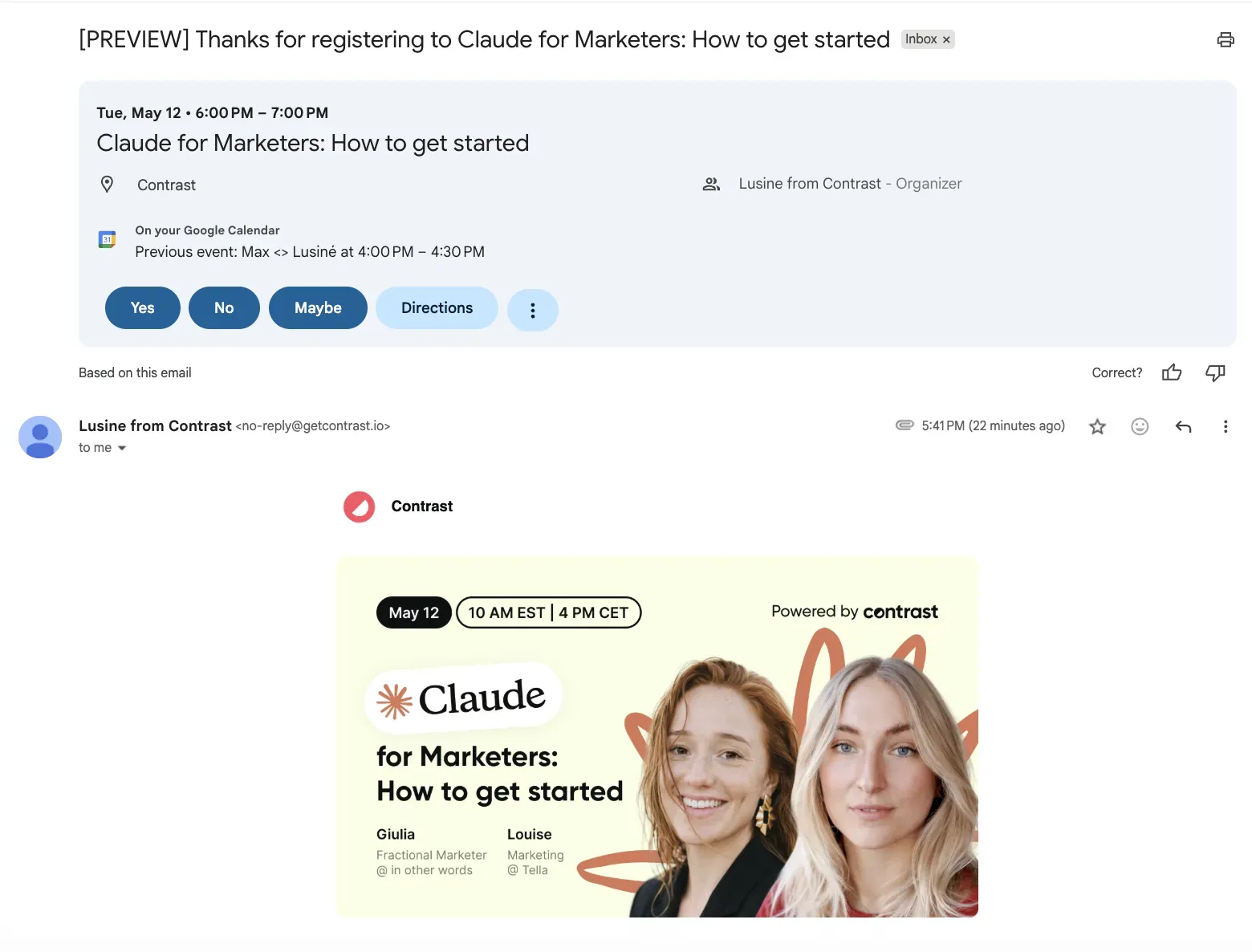
According to Contrast's 2026 data, most hosts send 2 reminders, but only 31% send more than one, meaning many registrants simply forget they signed up (see Stat 38: 67% of no-shows cite forgetting or getting busy). Top performers who implement a 3-step reminder sequence (day before, 1 hour before, 5 minutes before) see 27% higher live attendance rates. Including a calendar invite link in your confirmation email makes it even easier for attendees to save the date.
What this means for you: Add a 3-step reminder sequence including a calendar invite. This isn't spamming, it's helping people show up for something they've already committed to.

Webinar Costs
The cost of running webinars will impact the ROI of your webinar strategy. So how much does it actually cost to run a webinar?
55. The average cost per lead for webinars is $72
(Source: VisitorQueue)
This is 2.7x cheaper than trade shows ($800+) and nearly 2x cheaper than LinkedIn Ads ($110–200). At $72 per lead on average (ranging from $45 to $98), webinars offer a highly cost-effective path to high-quality B2B leads. When you factor in the long-term value of those leads and all the other potential benefits from webinars: content repurposing, engagement, SEO potential, webinars are arguably the best-value lead generation channel in B2B marketing.
What this means for you: If you’re looking to lower your cost per lead, webinars should be a core part of your strategy. They consistently deliver high-quality leads at a much lower cost than channels like ads or events, so it’s worth investing more budget and effort into making them a repeatable, scalable lead gen engine.
56. 78% of marketers credit webinars with helping to lower their cost per lead
(Source: Martal Group)
Webinars already stand out as a cost-efficient lead channel, with an average cost per lead of $72. What makes this even more compelling is that 78% of marketers say webinars directly help reduce their cost per lead, reinforcing the idea that it’s not just a "cheap channel" by default, it actively improves efficiency. This happens because webinars combine education and engagement in one format, attracting more self-qualified leads who are already interested, which naturally lowers acquisition costs over time.
What this means for you: Webinars don’t just start off cost-effective, they get more efficient over time. As you run more webinars and refine your targeting, content, and follow-ups, you’ll attract better-qualified leads and reduce wasted spend, making your overall acquisition strategy smarter, not just cheaper.
57. A webinar session generates a 2.5x higher return on investment than in-person events
(Source: EntrepreneursHQ)
Webinars deliver about 2.5x higher ROI than in-person events, mainly because they cut out major costs like travel, venues, and logistics while still reaching a large, targeted audience. Instead of spending heavily on physical setups, marketers can focus budget on content and promotion, which drives more efficient lead generation and conversions. This makes webinars a much more scalable way to get strong returns compared to traditional events.
What this means for you: If you’re already doing physical events, it’s worth comparing what each one is really costing you. Webinars aren’t meant to replace in-person events, but running both together can often give you better results for the same (or lower) spend.
Webinar Repurposing Statistics
Webinar repurposing is the new trend in the webinar space, and is saving marketers a lot of time, but how efficient is repurposing?
58. 87% of B2B Marketers use AI for their webinars and virtual events
(Source: Teleprompter)
AI has completely transformed the webinar workflow for B2B marketers. Generative AI has changed the game for content creation from virtual events. One webinar can now become weeks of content across multiple channels without the manual transcription, writing, and editing that used to follow every session.
What this means for you: AI should be part of your webinar workflow. Use it to quickly turn one webinar into multiple pieces of content like emails, social media posts, and clips, so you get more value out of every session without spending hours repurposing it manually.
59. AI repurposing saves marketers 16,000+ hours and $800,000 per year
(Source: Contrast)
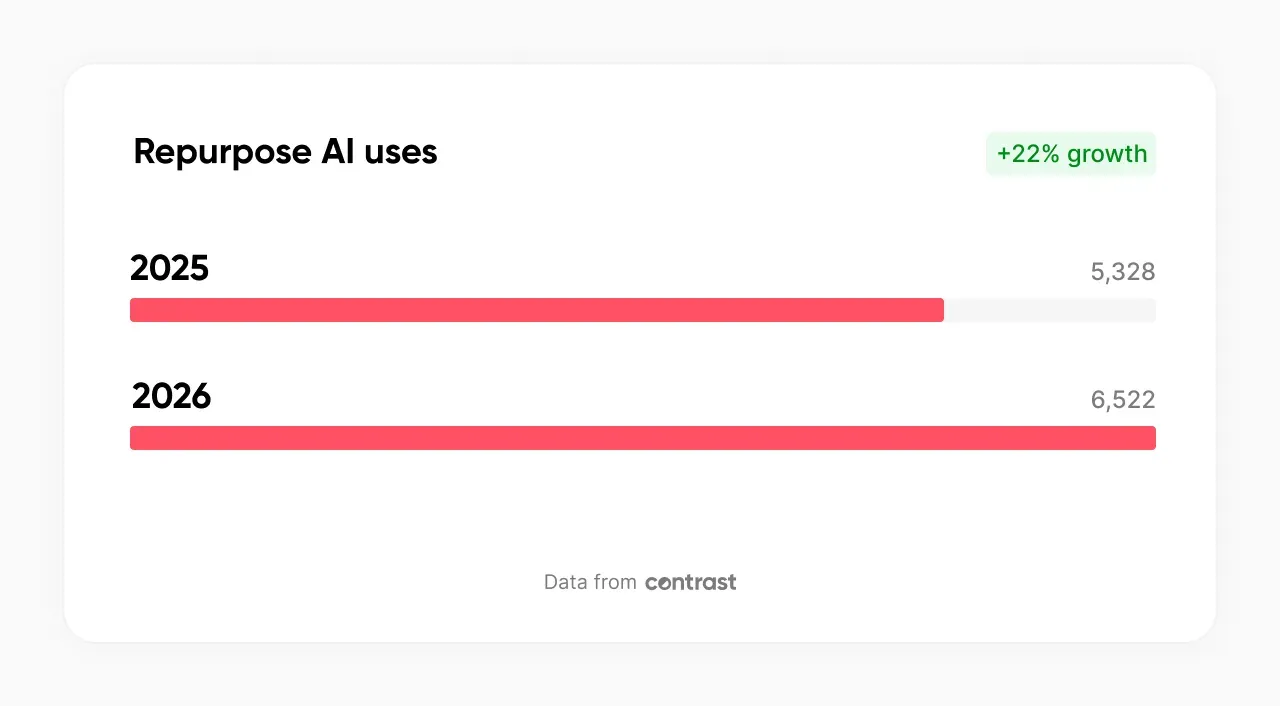
Up significantly from last year's figures of 13,000 hours and $650,000. In the past year, Repurpose AI was used 6,522 times (up from 5,328) to automatically generate blog posts, articles, and campaign materials directly from webinar transcripts.
Let me show this to you in numbers: it takes approximately 2.5 hours to manually write a blog post from a webinar. Multiply that by 6,522 uses at $50/hour in copywriting labor, and you've saved over 16,000 hours and roughly $800,000. Beyond the efficiency gains, AI repurposing multiplies the reach of each webinar turning a 200-person live audience into a content stream that reaches thousands across email, social, and search.
What this means for you: Start with one AI-generated blog post from your next webinar transcript.
60. Each webinar has potential to create 5 short clips on average
(Source: Contrast)
AI analysis of hundreds of webinars have shown that the average webinar has 4 or 5 moments that could be made into clips with high virality scores: sharing personal experiences or anecdotes, numbers, stories or more. In the past year, Clip AI was used 6,644 times to identify and cut these moments automatically.
Creating these clips is simple: you can highlight parts of the script yourself to cut into shorts, or let AI automatically select the most engaging moments. These clips can then be shared across social media, emails, and landing pages to keep your content working long after the webinar ends.
What this means for you: Clip your next webinar. Five short videos from one session can fuel weeks of social content.

Turn 1 webinar into 15 pieces of content
Use AI to transcribe, suggest, and repurpose your webinar into new formats
Book a demoConclusion
There you have it — 60 webinar statistics to help you start or sharpen your 2026 webinar strategy.
The main lesson remains the same as last year: you need to adapt to your audience. When's the best day for them? What time are they available? What content will genuinely help them? And 2026 adds a new layer of urgency to getting this right. With 91% of B2B professionals naming webinars as their favorite content format, and nearly 63% making purchase decisions after attending one, the upside of a great webinar program has never been higher.
The better you understand your audience, the better webinars you'll be able to create for them.
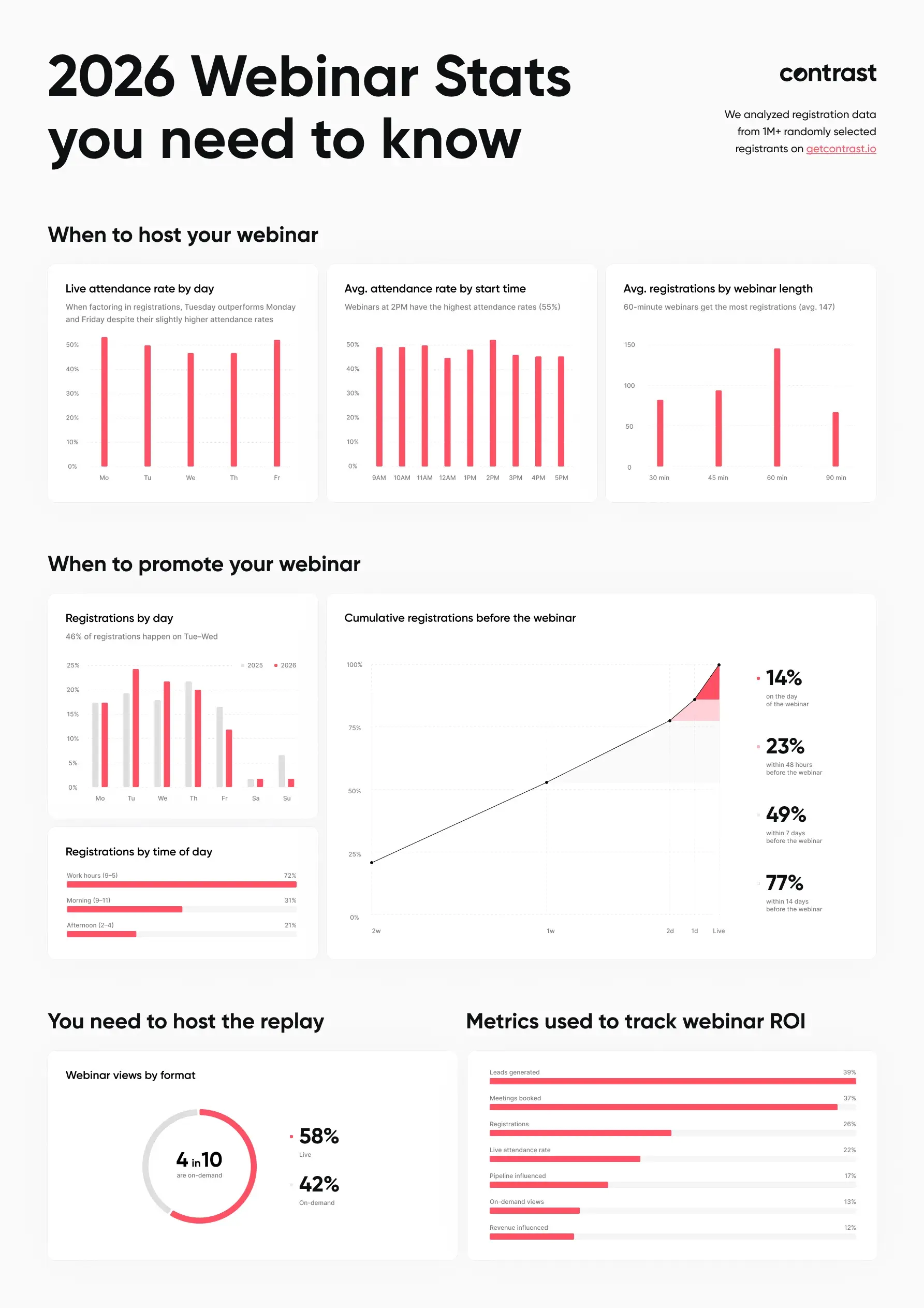
Save this cheat sheet so you can remember the key numbers:
Frequently asked questions (FAQs)
What is the average webinar attendance rate?
According to Contrast's 2026 data, the average live attendance rate across all webinars is approximately 44-50%, depending on the day and time of week. Tuesday webinars see the highest average attendance at 50%. Webinars with fewer than 100 registrants consistently outperform larger webinars, with 6% higher attendance rates.
What is the best day to host a webinar?
According to Contrast's 2026 data, Tuesday delivers the highest live attendance rates at 50%, making it the best day to host if maximizing live turnout is your priority. However, Thursday webinars attract the most total registrants on average about 8% more than Tuesday. If you want more sign-ups, choose Thursday. If you want more of those sign-ups to actually show up live, choose Tuesday.
What is the best time to host a webinar?
According to Contrast's 2026 data, 2PM has the highest average live attendance rate at 53%, followed by 11AM at 50% and 10AM at 49%.
How long should a webinar be?
According to Contrast's 2026 data, 60-minute webinars attract the most registrations, making them the best default format. However, 90-minute webinars have the highest live attendance rate (72%), suggesting that longer sessions attract more committed, motivated attendees.
What percentage of webinar views are on-demand?
According to Contrast's 2026 data, 42% of all webinar views come from on-demand replay.
How many registrants does the average webinar get?
According to Contrast's 2026 data, the average webinar attracts 128 registrants.
What is the average cost per lead for a webinar?
The average cost per lead for webinars is $72, ranging from $45 to $98.
How many reminder emails should you send before a webinar? According to Contrast's 2026 data, top-performing webinar hosts send 3 reminder emails: 1 day before, 1 hour before, and 5 minutes before the event. This 3-step sequence results in 27% higher live attendance rates compared to sending fewer reminders.
What type of webinar content generates the most ROI?
According to Contrast's 2026 survey of 524 B2B marketers, educational sessions generate 53% more ROI than product demo webinars.
Sources:
Contrast
Martal group
Letter.ly
Affiliate Booster
Teleprompter
Custom Market Insights
Entrepreneurs HQ
Content Marketing Institute