
When to Promote Your Webinar: The Best Days and Times That Actually Work

Most marketers focus on picking the perfect webinar topic, designing a beautiful landing page, and writing the best emails to get people to sign up. But there’s one factor that’s just as important and often completely overlooked.
It’s when you ask them to sign up.
This article is part of our 2026 research on webinars, based on analysis of 1M+ webinar registrants and insights from 524 B2B marketers.
If you want the complete set of 60 webinar statistics, check out the full report.
This page focuses specifically on one key question: When to promote your webinar.
In this article, you'll discover the surprising patterns we uncovered about the best days, times, and promotional windows to maximize your webinar signups and attendance. Because when it comes to webinars, it’s not just about what you say, it’s about when you say it.
Why Timing Your Webinar Promotion Actually Matters
Look, we all know people are busy. Their inboxes are packed, their calendars are full, and they're constantly deciding what deserves their attention.
The difference between a webinar that fills up and one that flops usually comes down to catching people at the right moment. When they're actually thinking about their professional development instead of just trying to survive the day.
Promote too early and they’ll forget. Promote too late and they’ll already have plans.

Want to Run Better Webinars?
Get a personalized demo and see how Contrast can elevate your webinars
Book your demoThe Webinar Promotion Timeline: Week by Week
4 Weeks Out: Launch Awareness, Don't Chase Registrations
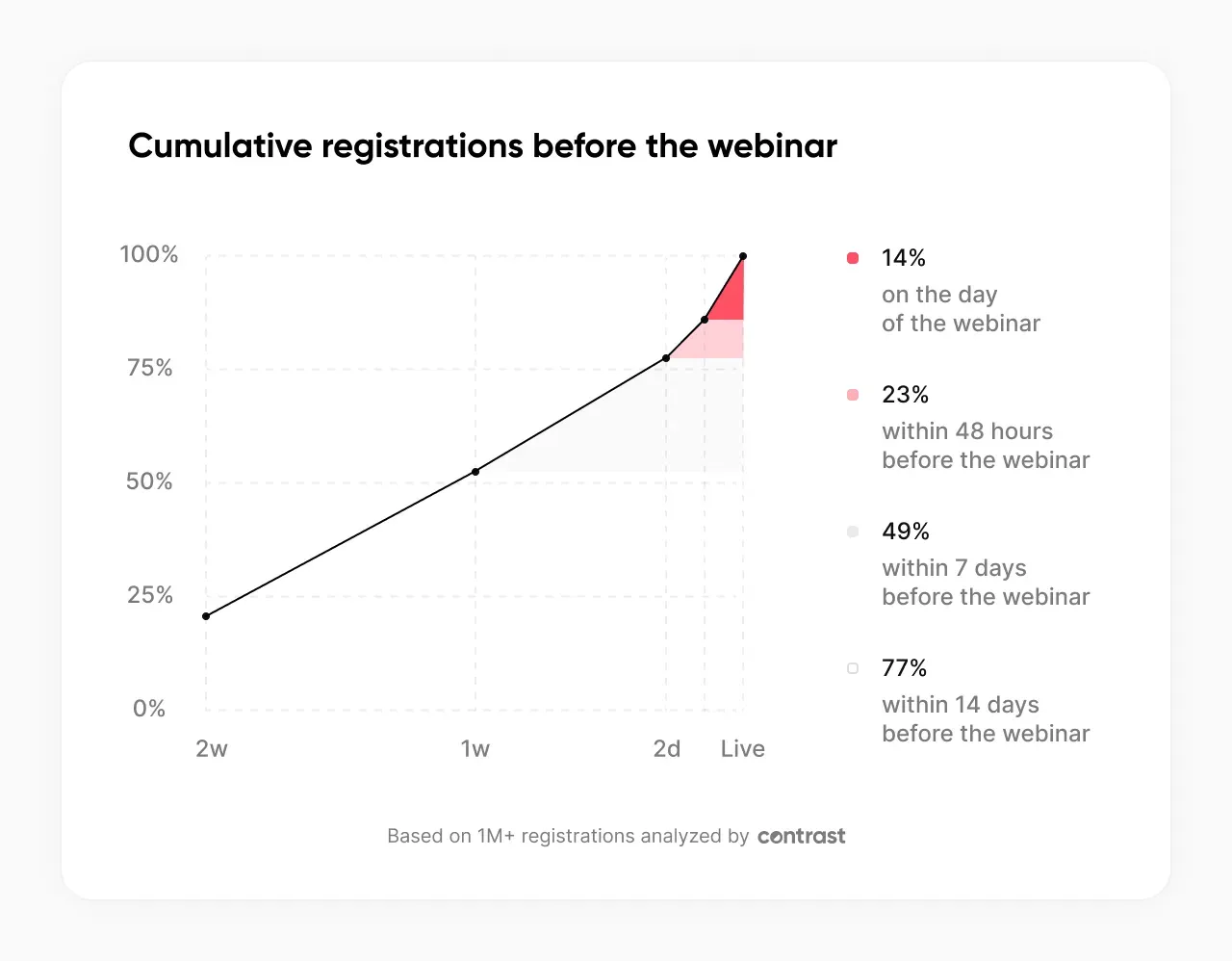
This is your soft launch. The goal isn't volume. Only 3% of people register more than 4 weeks out (Source: Contrast Webinar Stats Report 2026). The goal is planting the seed so that when you hit hard later, your audience has already heard of it.
What to do at 4 weeks:
- Publish your registration page and make it live
- Send a single "save the date" email to your list with just the topic and date
- Post once on LinkedIn and any relevant social channels
- Brief your speaker or co-host so they can mention it in their own channels
- Set up your automated confirmation email with a calendar invite link — this is non-negotiable from day one
Choose a webinar platform that automatically sends branded confirmation and reminder emails, including calendar invites. If you need to set it up manually, check out this mini-guide.
What not to do: Don't send multiple emails yet. Don't run paid promotion yet. You're building awareness.
2-3 Weeks Out: Build Momentum, Introduce the Value Proposition
This is where your content starts doing real work. You have enough lead time that people can genuinely consider blocking their calendar, and the event feels tangible enough to commit to.
What to do at 2-3 weeks:
- Send your main promotional email. Use your strongest copy. Lead with the outcome, not the agenda. "How to reduce sales follow-up time by 40%", and not "Webinar: CRM Features Overview"
- Run a second social push with a different angle — tease a specific insight, a data point, or a question you'll answer in the session
- If you're running paid promotion, start it now. Two weeks gives enough runway to optimize before the event
- Ask your speaker to promote to their audience at this stage
Email tip: Every send should have a single CTA. One registration link. No competing offers, no secondary asks.
Final Week: This Is Where Registrations Actually Happen
49% of all registrations happen in the 7 days before the event (Source: Contrast Webinar Stats Report 2026). This is your primary conversion window, and it's where most of your promotional energy should be concentrated.
Your final-week send schedule:
| Day | Action |
|---|---|
| 7 days out | "One week to go" email — reinforce the value, include social proof or speaker credentials |
| 5 days out | Social push — use a different format (short video, carousel, quote graphic) |
| 3 days out | Second email — lead with urgency ("seats are filling") or a compelling data point from the session |
| 1 day out | "Tomorrow" reminder — short, punchy, one CTA |
| 1 hour before | Reminder to registered attendees via email |
| 5 minutes before | "We're going live now." Final reminder to registered attendees |
Change your message at every touchpoint. If every email says the same thing, people stop reading after the second one. Each send should lead with a different angle: the problem it solves, a specific insight from the session, the speaker's story, a data point that creates curiosity.
Day of the Webinar
14% of people register on the day of the event itself (Source: Contrast Webinar Stats Report 2026). Day-of promotion is a tactic for capturing the segment that always decides late.
A "we're going live in 2 hours" email or social post consistently converts. Don't skip it.
Contrast automates your entire reminder sequence — confirmation email with calendar invite on registration, reminders and follow-up emails. See how reminders work →
The Best Days and Times to Send Promotion Emails
The full timing data is in the 2026 Webinar Stats Report, but here's what you need for your send schedule:
Best days: Tuesday is the top day for webinar registrations, followed closely by Thursday (Source: Contrast Webinar Stats Report 2026). Build your email cadence around these two days wherever possible. Avoid Monday (inbox is too busy) and Friday (attention already elsewhere).
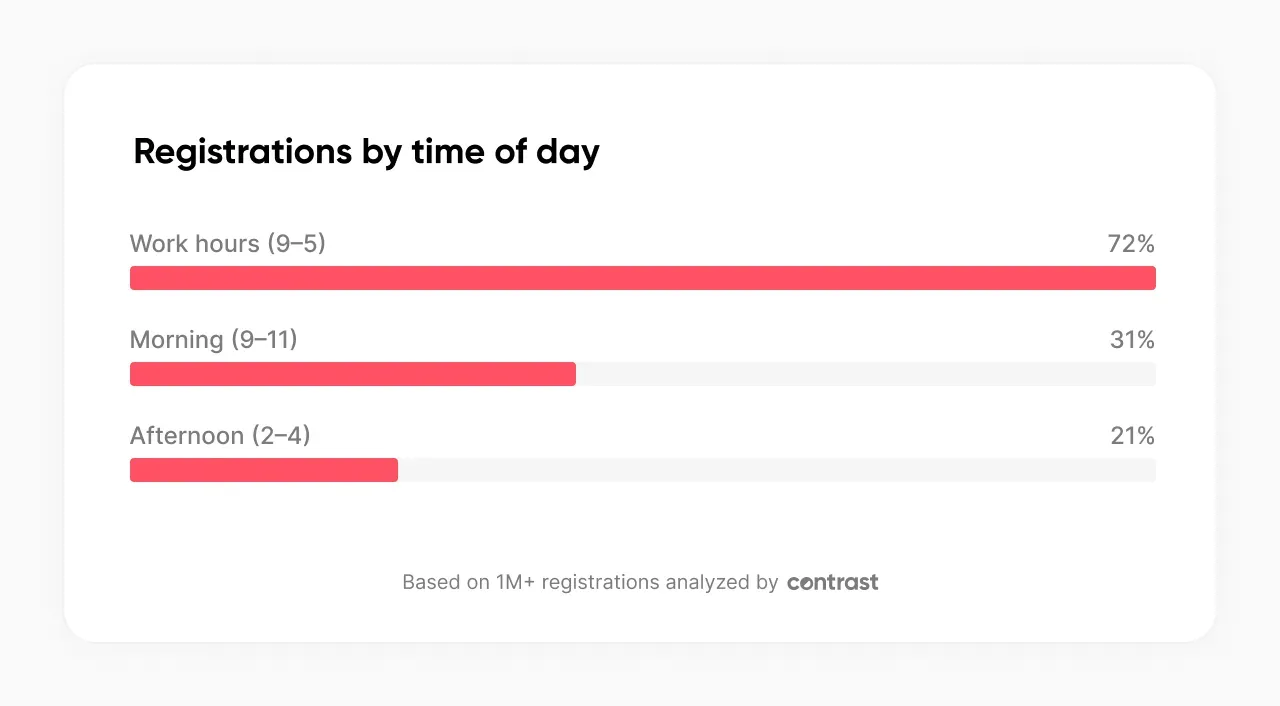
Best time window: Send emails to land between 9AM-11AM. This is when open rates and decision-making intent are both highest — people are planning their day, not reacting to it. A secondary window of 2PM-4PM works well for follow-up sends (Source: Contrast Webinar Stats Report 2026).
Time zone note: If your audience spans regions, optimize for your largest segment. A 9AM EST send is 2PM CET — that catches both morning planners in the US and afternoon focus time in Europe.
Channel-by-Channel Promotion Breakdown
Email (Primary Channel)
Email drives the majority of webinar registrations for most B2B teams. Your list is your most direct line to an audience that already knows you. Prioritize it.
- Use lightly designed emails — they tend to outperform heavy HTML for click-through
- Subject lines that lead with the outcome or a specific number perform strongest ("How we increased pipeline by 40% — live webinar")
- Don’t overcomplicate the body: clear context, a few sharp takeaways, and a strong CTA
LinkedIn (Secondary Channel)
LinkedIn is the most effective social channel for B2B webinar promotion. Post 3-4 times across your promotional window, each with a different angle:
- Week 1: Announce with the "what and why"
- Week 2: Tease a specific insight or framework from the session
- Final week: Social proof — speaker credentials, company name, or early registration numbers
- Day of: "We're live today" with the join link
Get your speaker to post too. Their network is a warm audience you can't reach otherwise, and personal posts consistently outperform company page posts on LinkedIn.
Paid Promotion
If you have budget, retargeting works well for webinars — particularly targeting people who visited the registration page but didn't convert. Start paid at 2-3 weeks out and run it through to the day before.
Thought leader ads (run from a person’s profile instead of a company page) tend to outperform standard ads pretty consistently. In most campaigns, you’ll see noticeably higher engagement rates — often 2-3× higher CTR and cheaper CPCs. That usually translates into a lower cost per registration as well.
Partner and Community Channels
If your speaker, sponsor, or a partner has a relevant audience, this is often the highest-converting channel you have, because it comes with built-in trust. Brief your partners at the 3-week mark with a ready-to-use message they can share without any extra effort on their end.
5 Common Webinar Promotion Mistakes (That Could Be Costing You Attendees)
- Overloading People with Too Many Links or CTAs
Confusing your audience with multiple registration buttons, competing offers, or extra links can backfire. Keep your promotion focused on one clear action — registering for your webinar — to avoid decision paralysis. - Using the Same Message in Every Promotion
If all your invites and reminders say the exact same thing, people tune out. Instead, highlight different angles in each touchpoint — for example, one email focuses on the key pain point, another teases an insight or framework you’ll share, and another spotlights the speaker’s credibility or story. - Not Optimizing Your Registration Page for Mobile
Around 30% of your audience will check out your webinar invite on their phone first. If your registration page isn’t mobile-friendly, loads slowly, or requires endless form fields, you’re silently losing potential attendees before they even hit “register.” - Not Setting Up Calendar Invites Automatically
Even if someone registers, life is busy. If your confirmation email doesn’t include an easy "Add to Calendar" link, you’re relying on them to remember on their own — and that’s just not how humans work. Always make it effortless for them to save the date immediately. - Assuming People Know Why They Should Care
Many webinar invites focus on what the session is (topic, speaker, agenda) but forget to clarify why it actually matters for the attendee. Every promotion should answer the silent question in your reader’s mind: “How will this help me today?” If you skip this, even perfectly timed promotions will fall flat.
Your Webinar Promotion Checklist
Use this for every webinar you run:
4 weeks out
- Registration page live
- Confirmation email with calendar invite configured
- "Save the date" email sent
- Speaker briefed and given shareable assets
2-3 weeks out
- Main promotional email sent (outcome-led, single CTA)
- LinkedIn posts scheduled (3-4 across the window)
- Paid promotion launched if applicable
- Partner/speaker promo activated
- Included in the Newsletter (if you have one)
Final week
- "One week to go" email sent
- "3 days out" urgency email sent
- Social push with different format/angle
- "Tomorrow" reminder sent
- Day-of reminders scheduled
Day of
- Morning email sent to full list
- "Going live in X hours" social post published
- Reminders sent to registered attendees (1 hour and 5 minutes before the live)
Conclusion
There’s no one-size-fits-all formula. Your audience might be different. Your industry might have different patterns. But these stats give you a solid starting point.
People don't plan as far ahead as you think they do. They're busier than ever, more distracted than ever, and they need multiple touchpoints to actually follow through.
So stop stressing about the perfect promotion timeline. Start promoting early for awareness, hit hard in the final week, and keep going until you're live. Focus on Tuesday through Thursday, time your emails for business hours, and always, always send those reminders.
Most importantly, track what works for your specific audience. These stats are your baseline, not your ceiling.
For the full dataset behind this playbook including registration timing by day, attendance patterns, and engagement benchmarks see the complete 2026 Webinar Stats Report.
The Best Webinar Experience for your Viewers
Start for free with up to 30 registrants. No credit card needed.
Start for freeFrequently Asked Questions (FAQs)
How far in advance should you promote a webinar?
Start building awareness 4 weeks out, but expect the bulk of registrations to come much later. According to Contrast's 2026 data from 1M+ registrants 77% of people register within the final 2 weeks, and 48% in the last 7 days. Early promotion creates awareness, your final-week push is what converts it into sign-ups.
Should I promote my webinar on the day it's happening?
Yes! 14% of registrations happen on the day of the event itself (Source: Contrast Webinar Stats Report 2026). If you stop promoting, you’re essentially leaving those people behind.
What is the best day to send webinar invitation emails?
Tuesday is the strongest day for webinar registrations (Source: Contrast Webinar Stats Report 2026), with Thursday a close second. For send time, aim for emails to land in the 9AM-11AM window, that's when open rates and registration intent are both highest. The 2PM-4PM window is a reliable secondary slot for follow-up sends.
How many emails should I send to promote a webinar?
For a standard campaign: one save-the-date at 4 weeks, one main promotional email at 2-3 weeks, then 3-4 sends in the final week (7 days out, 3 days out, day before, day of). That's 6-7 total touchpoints. Don't forget to change the message for each email. Each email and post should lead with a different angle — the outcome, the speaker story, a data teaser, the specific problem it solves.